


Seasonal rest timing
Plan any repotting, leaf division, or relocation for late spring to early summer, and keep the plant almost completely dry during its late fall–winter rest so new leaves do not compete with old ones for limited stored moisture.

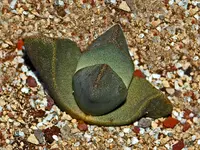
Pleiospilos bolusii, often called stone quaggafig, is a small succulent that mimics pebbles or split rocks. Its thick, paired leaves store water and help it survive long dry spells. This plant is native to arid regions of South Africa, where it grows in rocky, well-drained soils and receives intense sun but very little rainfall. Its slow growth and compact size make it suited to small containers and windowsills. The main challenges in how to care for Stone Quaggafig are avoiding overwatering and providing enough light without extreme heat. When given bright light, gritty soil, and careful watering, it is a relatively low-maintenance plant.

Care Difficulty
Moderate Care

Light Preference
Full Sun

Water Requirements
Low Water

Temperature Preference
Tropical / Frost Sensitive

Hardiness Zone
10–11

Soil Texture
Sandy, Rocky, Loamy

Soil pH
Slightly acidic (6.5–7.0), Neutral (7.0)

Soil Drainage
Well-drained

Fertilization
Minimal (feed rarely)
Scan your plant to receive care tips personalized for your specific plant
Available on iOS and Android
This compact succulent thrives in bright, intense light that mimics its South African habitat.
This species stores water in its thick leaves and is highly sensitive to excess moisture.
This succulent prefers warm, dry air and is sensitive to cold, damp conditions.
Humidity is largely irrelevant for this arid succulent if air stays dry and well ventilated.
This species needs a very fast-draining, mineral-based mix that dries quickly between waterings.
This compact succulent is very suitable for container growing.
This slow-growing Stone Quaggafig requires only light feeding to avoid soft, overgrown tissue.
Pleiospilos bolusii needs almost no pruning, since it stays compact and naturally sheds old tissue.
This succulent prefers infrequent disturbance and thrives slightly root-bound in a small, very free-draining pot.
Propagation of Pleiospilos bolusii is most reliable from seeds, with clump division used only on well-established plants.
This species is not frost hardy and needs careful winter care in most temperate climates.

Plant Health Check
Not sure what's wrong with your plant? Check your plant's health inside the app.
This species forms very thick, paired leaves that split along the center, closely mimicking the color and texture of the quartzite and shale stones of its native South African habitats, which reduces herbivory by making the plant harder for animals to recognize as food.
The daisy-like yellow flowers emerge from the central fissure between the two leaves and can be almost as large as the body of the plant, an adaptation that allows a substantial floral display while keeping the rest of the plant compact and protected.
In its natural growth cycle, new leaf pairs develop inside the old ones and gradually absorb their stored water and nutrients, so the outer leaves shrivel and dry as the inner pair fully matures, a strategy that conserves resources in an arid climate.

In the wild, this species often grows partially sunken into gritty, stony soil so that only the leaf tops are visible, an extreme form of camouflage that makes it blend almost perfectly into scattered rock fragments and helps it survive in exposed, low-rainfall environments.
Lack of flowers usually comes from insufficient light, irregular cool rest in winter, or past overwatering that damaged roots. Stable, bright conditions over several seasons are often needed before this slow succulent resumes reliable flowering.
Keep your plants happy and healthy with plant identification, disease detection, and easy care guidance.

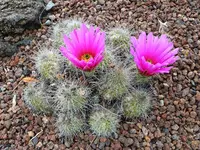
strawberry hedgehog cactus
Echinocereus stramineus
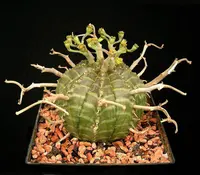
Zebra Milkball
Euphorbia meloformis
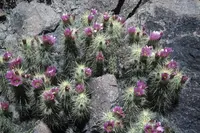
pinkflower hedgehog cactus
Echinocereus fendleri
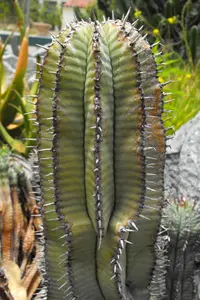
snowflake spurge
Euphorbia polygona
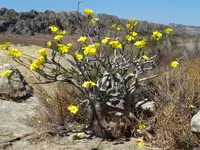
Elephant's Foot Plant
Pachypodium rosulatum
woolly nipple cactus
Mammillaria nivosa
Crassula volkensii
Crassula volkensii
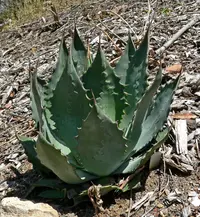
Agave wocomahi
Agave wocomahi