Seasonal rest period
From late fall through winter, keep the plant much drier and avoid repotting or disturbing the roots so it can complete its natural rest and leaf replacement cycle without stress.

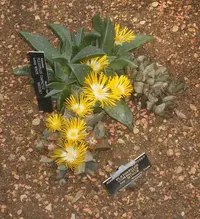
Ostrichfoot Quaggafig, Pleiospilos compactus, is a small succulent from arid regions of South Africa. It forms tight clumps of thick, paired leaves that resemble smooth stones. The leaves are gray-green with fine speckles, helping the plant blend into rocky habitats.
This species grows slowly and stays compact, making it suitable for small indoor pots and bright windowsills. It typically produces a single, daisy-like flower that opens in strong light.
Its stone-like form, drought tolerance, and slow growth make it relatively easy to manage if overwatering is avoided. Those who want to learn how to care for Ostrichfoot Quaggafig should focus on strong light, very fast-draining soil, and careful, infrequent watering.

Care Difficulty
Moderate Care

Light Preference
Full Sun

Water Requirements
Low Water

Temperature Preference
Tropical / Frost Sensitive

Hardiness Zone
10–11

Soil Texture
Sandy, Rocky, Loamy

Soil pH
Slightly acidic (6.5–7.0), Neutral (7.0)

Soil Drainage
Well-drained

Fertilization
Minimal (feed rarely)
Scan your plant to receive care tips personalized for your specific plant
Available on iOS and Android
This compact South African succulent prefers bright conditions that mimic open, rocky habitats.
This species stores water in its thick leaves and must dry thoroughly between waterings.
This succulent prefers warm, dry conditions with cool but not freezing nights.
Humidity is not a key factor for Pleiospilos compactus, which thrives in dry indoor air similar to Ostrichfoot Quaggafig habitats.
This species needs a very fast-draining, mineral-based mix to prevent root and stem rot.
This compact succulent is very suitable for container growing.
Pleiospilos compactus needs very modest feeding due to its slow, compact growth.
Pleiospilos compactus requires almost no structural pruning, only occasional cleanup.
This slow-growing succulent prefers tight quarters and infrequent repotting.
Propagation of Pleiospilos compactus is most reliable from seed under controlled conditions.
This species is not frost hardy and needs careful winter management in most climates.

Plant Health Check
Not sure what's wrong with your plant? Check your plant's health inside the app.
This species grows as low, split gray-green mounds that closely match surrounding pebbles and quartzite in its native South African habitats, an adaptation that helps it avoid herbivores in open, exposed sites.
Pleiospilos compactus typically produces large, daisy-like, orange to yellow flowers in late autumn to winter in the Southern Hemisphere, opening in the afternoon and closing at night in response to temperature and light changes.
Each leaf pair acts as a water-storage organ, allowing the plant to survive long dry periods in its semi-arid Karoo range, where rainfall is low and irregular.

In habitat, Pleiospilos compactus often grows partially sunken into shallow rock crevices and gritty soil pockets, so only the upper surface of the leaves is exposed, which reduces water loss and further enhances its camouflage among stones.
This species stays very small, usually forming a clump about 3–5 cm tall and 5–8 cm across. Over many years it may slowly divide into several heads, but it still remains compact and low-growing.
Keep your plants happy and healthy with plant identification, disease detection, and easy care guidance.