Rotate Growing Trays
If cultivating in shallow trays or boxes, rotate them 90° every few days so developing fruiting bodies receive even airflow and light exposure, which helps keep the stems straight and reduces patchy growth.

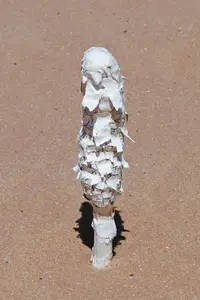
Desert shaggymane (Podaxis pistillaris) is a desert-adapted fungus, not a leafy houseplant. It forms tall, club-shaped fruiting bodies that look like dry, shaggy mushrooms pushing up from sandy ground.
This species occurs mainly in arid and semi-arid regions, often on disturbed soils, termite mounds, or sandy desert flats. Its tough, dry structure and slow development reflect strong adaptation to heat and low moisture.
Because it is specialized for harsh, open habitats, it is not commonly grown indoors or in typical gardens. Anyone wanting to care for Desert Shaggymane should know it prefers very dry, well-drained substrates, full sun, and minimal disturbance.

Care Difficulty
Moderate Care

Light Preference
Full Sun

Water Requirements
Low Water

Temperature Preference
Warm Climate

Hardiness Zone
Unknown

Soil Texture
Sandy, Rocky

Soil pH
Neutral (7.0), Slightly alkaline (7.0–7.5)

Soil Drainage
Well-drained

Fertilization
Minimal (feed rarely)
Scan your plant to receive care tips personalized for your specific plant
Available on iOS and Android
This desert fungus thrives in strong sun but tolerates some shade in very hot climates.
This species is highly drought-adapted and needs very little supplemental water once established.
This desert-adapted species tolerates a wide temperature range but is sensitive to prolonged cold and hard frost.
This desert fungus handles very dry air and humidity is rarely a limiting factor.
Podaxis pistillaris thrives in very loose, fast-draining, low-organic substrates that mimic sandy desert soils.
This species is generally unsuitable for container growing because its natural habit relies on open, freely draining desert ground.
Podaxis pistillaris is adapted to nutrient-poor desert soils and usually grows well without added fertilizer.
Podaxis pistillaris needs almost no pruning, since its fruiting bodies are seasonal and short-lived.
This desert fungus is rarely grown in containers, so care focuses on minimal disturbance when shifting its growing site.
Podaxis pistillaris is typically propagated by spores rather than vegetative methods like cuttings or division.
Podaxis pistillaris is adapted to arid, often warm climates and generally needs no special winter protection in frost-free regions.

Plant Health Check
Not sure what's wrong with your plant? Check your plant's health inside the app.
The dark, powdery spore mass of this fungus has been traditionally mixed with liquids and used as a writing ink in some arid-region cultures, taking advantage of its strong, persistent pigmentation.
Its tough, woody, club-shaped fruiting body is adapted to withstand intense desert winds and blowing sand, allowing it to persist long after many other mushrooms would be destroyed.
In parts of Africa and Asia, this species often fruits near or on termite mounds, where the altered soil structure and microclimate provide favorable conditions for its development.

Molecular studies have shown that this desert-adapted fungus is more closely related to the parasol mushrooms (family Agaricaceae) than to true puffballs, despite its puffball-like appearance.
Yes. This fungus reproduces by spores, which function like seeds. Collect mature, dry caps, crumble them over a sterile, sandy substrate, and keep slightly moist with good air circulation. Germination and fruiting are irregular and weather‑dependent.
Keep your plants happy and healthy with plant identification, disease detection, and easy care guidance.