Early leader selection
In the first 2–3 years, choose a single strong vertical stem as the main leader and remove competing upright shoots to develop a stable tree structure and reduce future storm damage risk.

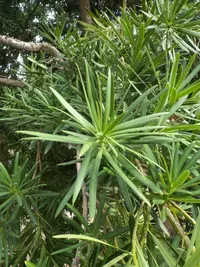
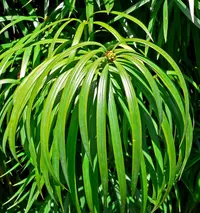
Brown pine, Podocarpus neriifolius, is an evergreen coniferous tree valued for its neat, narrow leaves and dense, refined form. It often grows with a strong central trunk and layered branches, giving a clean, architectural look in gardens or large containers.
This species is native to tropical and subtropical forests in South and Southeast Asia, where it experiences warm temperatures and steady moisture. In cultivation, it responds well to bright light, moderate watering, and well-drained, slightly fertile soil.
Its relatively slow growth, tolerance of pruning, and general toughness make it suitable for patient growers who want to learn how to care for Brown Pine without dealing with a very demanding species.

Care Difficulty
Moderate Care

Light Preference
Partial Sun

Water Requirements
Moderate Water

Temperature Preference
Tropical / Frost Sensitive

Hardiness Zone
10–12

Soil Texture
Sandy, Loamy, Organic-rich

Soil pH
Acidic (5.5–6.5), Slightly acidic (6.5–7.0)

Soil Drainage
Moist but well-drained

Fertilization
Minimal (feed rarely)
Scan your plant to receive care tips personalized for your specific plant
Available on iOS and Android
This species prefers bright, indirect light and benefits from some gentle direct sun.
This conifer prefers evenly moist but not saturated soil, with brief drying at the surface between waterings.
This warm-climate tree grows best in stable, mild to warm temperatures without frost exposure.
This species prefers moderate humidity but usually adapts to typical household levels.
Soil for Podocarpus neriifolius should be well-drained, moderately fertile, and slightly acidic to neutral.
This species is suitable for container growing when given a stable, well-drained setup.
This species benefits from light, steady feeding rather than heavy doses when grown as Brown Pine indoors or in containers.
Pruning helps maintain structure and density in Podocarpus neriifolius without stressing the plant.
Container-grown plants and young landscape specimens benefit from careful repotting or transplanting to support steady growth.
Podocarpus neriifolius is most often propagated from semi-hardwood cuttings rather than seed in home settings.
This tropical to subtropical conifer is not reliably hardy in freezing climates and needs thoughtful winter care in cold regions.

Plant Health Check
Not sure what's wrong with your plant? Check your plant's health inside the app.
This species has long, narrow leaves that resemble those of willow and oleander, an adaptation that helps it shed excess water efficiently in its native humid, high‑rainfall forests.
It occurs naturally from the eastern Himalayas and Southeast Asia through parts of Indonesia and Papua New Guinea, showing a strong ecological tolerance for warm, moist lowland to mid‑elevation forests.
Instead of typical woody cones, it produces modified seed cones with a fleshy, often brightly colored receptacle that attracts birds, which then disperse the seeds.

Podocarpus neriifolius is one of the most widely distributed broad‑leaved podocarps, spanning a large geographic range across tropical Asia and the western Pacific while remaining primarily a forest canopy or subcanopy tree rather than a shrub, which is unusual within its genus.
Growth is moderate. In suitable subtropical or tropical climates, this species often adds 20–40 cm of height per year, sometimes more when young, given consistent moisture, warmth, and adequate root space in the ground or large containers.
Keep your plants happy and healthy with plant identification, disease detection, and easy care guidance.