Mark Dormant Clumps
After foliage dies back in late summer, mark clump locations with unobtrusive stakes so you avoid disturbing crowns when mulching, dividing, or planting other shade perennials nearby.

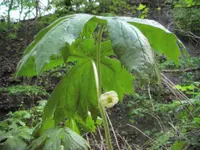
Mayapple, Podophyllum peltatum, is a woodland perennial native to eastern North America. It spreads by rhizomes to form colonies of umbrella-like leaves in spring. Each stem usually carries one or two large, lobed leaves and, on flowering stems, a single white flower hidden beneath the foliage. By summer, this flower develops into a fleshy yellow fruit. The plant prefers partial to full shade, moist but well-drained soil, and humus-rich woodland conditions. Its seasonal growth and rhizome spread influence how to care for mayapple, since it disappears after summer dormancy and needs space to naturalize over time.

Care Difficulty
Moderate Care

Light Preference
Partial Shade

Water Requirements
Regular Water

Temperature Preference
Cold Hardy

Hardiness Zone
3–8

Soil Texture
Loamy, Silty, Organic-rich

Soil pH
Acidic (5.5–6.5), Slightly acidic (6.5–7.0)

Soil Drainage
Moist but well-drained

Fertilization
Minimal (feed rarely)
Scan your plant to receive care tips personalized for your specific plant
Available on iOS and Android
This woodland perennial prefers dappled light that mimics a deciduous forest floor.
This species prefers consistently moist, cool soil without becoming waterlogged.
This temperate woodland plant is adapted to cool to mild conditions with a pronounced winter rest.
This woodland species prefers moderately moist air but usually adapts to typical outdoor humidity levels.
This species thrives in loose, humus-rich soil that mimics a moist deciduous forest floor.
This species can be grown in containers if the pot mimics a cool, shaded, woodland-like root environment.
This woodland native needs minimal feeding, as mayapple is adapted to nutrient-rich leaf litter rather than regular fertilizer.
Pruning needs for Podophyllum peltatum are very light and mainly focused on cleanliness rather than shaping.
This species is usually grown in the ground, so management focuses on careful transplanting rather than frequent repotting.
Podophyllum peltatum is most reliably propagated by division of rhizomes rather than by seed in home gardens.
This woodland perennial is cold hardy in much of the US and usually needs only simple winter preparation.

Plant Health Check
Not sure what's wrong with your plant? Check your plant's health inside the app.
This species spreads by underground rhizomes to form large clonal colonies, creating dense spring understories that look like miniature umbrella forests in deciduous woods.
Each fertile stem usually supports a single white flower that hangs beneath the leaf canopy, making it easy to miss unless viewed from below.
The yellow, ripened berry is eaten by wildlife such as box turtles and small mammals, which help disperse the seeds, but all parts of the plant, including the fruit, are considered toxic to humans.

The plant is a classic example of a spring ephemeral: it emerges, flowers, and sets fruit in early spring while tree canopies are still open, then its foliage often withers and disappears as the forest shade deepens and summer progresses.
Flowering occurs only on mature, two-leaved shoots. Plants grown from seed can take several years to reach flowering age. Excess disturbance, very dry spring soil, or heavy shade from trees can also reduce flower production.
Keep your plants happy and healthy with plant identification, disease detection, and easy care guidance.