Use rainwater trays
Place this moss on shallow trays filled with acid-neutral rainwater or distilled water above the substrate surface to keep the colony evenly moist without disturbing the delicate rhizoids when topping up moisture.

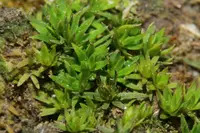
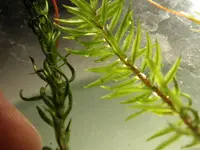
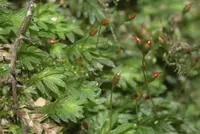
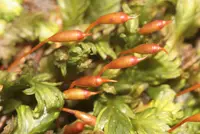
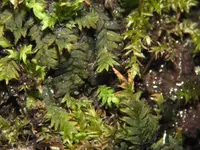
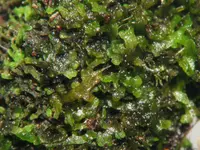
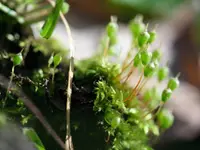
Pogonatum nanum is a small acrocarpous moss that forms dense, bright green tufts or cushions, often resembling a miniature forest of upright shoots. Each shoot carries narrow leaves that taper to a fine point, creating a neat, textured surface.
This species naturally occurs on moist, often acidic soils, rock crevices, and banks in temperate to subtropical regions, frequently in shaded or partially shaded habitats. Its compact size and slow, steady growth make it suitable for terrariums and detailed moss landscapes.
It prefers consistent moisture, gentle airflow, and protection from harsh, direct sun, so conditions must stay stable to care for Pogonatum nanum successfully.

Care Difficulty
Moderate Care

Light Preference
Partial Shade

Water Requirements
Keep Soil Moist

Temperature Preference
Cool Climate

Hardiness Zone
Unknown

Soil Texture
Peaty, Organic-rich, Loamy

Soil pH
Strongly acidic (4.5–5.5), Acidic (5.5–6.5)

Soil Drainage
Moist but well-drained

Fertilization
Minimal (feed rarely)
Scan your plant to receive care tips personalized for your specific plant
Available on iOS and Android
This moss prefers soft, indirect light that mimics a shaded forest floor.
This species thrives in consistently moist, never stagnant, conditions.
This moss prefers cool to mild, stable temperatures with good humidity.
This moss prefers consistently moist air to stay compact and healthy.
Pogonatum nanum grows best in moist, airy, acidic, organic-rich substrates that stay damp but not waterlogged.
This species is well suited to shallow container culture for close-up viewing and controlled moisture.
This moss is adapted to low‑nutrient environments and usually needs no additional fertilizer in normal culture.
Pogonatum nanum needs only minimal grooming to keep cushions neat and healthy.
Transplanting is mainly needed when clumps outgrow a dish, terrarium, or patch in a moist garden bed.
Pogonatum nanum is commonly propagated by division or from spores under controlled, moist conditions.
This moss is generally cold hardy and usually needs little specific winter care in the ground.

Plant Health Check
Not sure what's wrong with your plant? Check your plant's health inside the app.
Pogonatum nanum forms very small, dense tufts rarely exceeding a few centimeters in height, giving it a characteristic cushion-like appearance that distinguishes it from many taller Pogonatum species.
The leaf margins in this species often bear fine teeth and a distinct midrib that help channel and retain water films over the plant surface, an important feature for gas exchange and fertilization in mosses.
Like several Pogonatum species, P. nanum has specialized leaf cells that can accumulate silica, which gives the leaves a slightly rough texture and may provide structural support and some protection against herbivory.
This moss usually thrives better outdoors or in terrariums that mimic its cool, shaded forest habitat. Indoors, it needs stable moisture, high humidity, and soft, indirect light. Dry, heated rooms make long‑term success difficult.
Keep your plants happy and healthy with plant identification, disease detection, and easy care guidance.