Rhizome division timing
Divide clumps in early spring just as shoots emerge, cutting rhizomes into 2–3 bud segments and replanting at the same depth to rejuvenate growth and control spread.

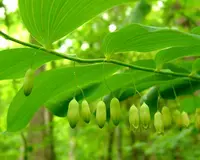
Hairy Solomon's seal, Polygonatum pubescens, is a shade-loving woodland perennial native to eastern North America. It naturally grows in rich, deciduous forests and along shaded slopes.
The plant forms graceful, arching stems with alternate, softly hairy leaves and small, greenish-white, tubular flowers that hang beneath the stems in spring. Later, it produces small blue-black berries.
It slowly forms clumps over time, creating a natural, layered look in shade gardens. Understanding how to care for hairy Solomon's seal is straightforward if the site mimics woodland conditions.
This species prefers dappled shade, consistently moist but well-drained soil, and protection from extreme heat or drought, which keeps it reliable and relatively low-maintenance once established.

Care Difficulty
Easy Care

Light Preference
Partial Shade

Water Requirements
Moderate Water

Temperature Preference
Cold Hardy

Hardiness Zone
3–8

Soil Texture
Loamy, Silty, Organic-rich

Soil pH
Acidic (5.5–6.5), Slightly acidic (6.5–7.0)

Soil Drainage
Moist but well-drained

Fertilization
Minimal (feed rarely)
Scan your plant to receive care tips personalized for your specific plant
Available on iOS and Android
This woodland perennial prefers cool, dappled light that mimics a shaded forest edge.
This rhizomatous perennial prefers consistently moist, never waterlogged soil.
This hardy woodland plant tolerates a wide temperature range but grows best in cool to mild conditions.
This woodland perennial prefers moderate humidity but usually adapts to typical home levels.
This species grows best in loose, moisture-retentive yet well-drained soil rich in organic matter.
This species is suitable for container growing when given a deep, stable pot that mimics its woodland root space.
This woodland perennial needs only modest feeding when grown in average, humus-rich soil, so focus on gentle, organic nutrition.
Pruning Polygonatum pubescens is minimal and mainly focuses on health and tidiness rather than shaping.
This species is most often grown in the ground, where transplanting is infrequent and should be done carefully to protect the rhizomes.
Polygonatum pubescens is most commonly propagated by division of rhizomes, with seed used mainly for long-term or conservation projects.
This woodland perennial is cold hardy in much of North America and usually needs little active winter care in the ground.

Plant Health Check
Not sure what's wrong with your plant? Check your plant's health inside the app.
Polygonatum pubescens is distinguished from related North American Solomon’s seal by its fine hairs on stems and leaf undersides, an adaptation linked with its preference for cool, deciduous forests with rich, mesic soils.
The plant bears its greenish-white tubular flowers in pairs or small clusters from the leaf axils along arching stems, a trait that helps botanists separate it from similar species with solitary flowers.
This species is native to eastern North America, where it occurs from parts of southeastern Canada through the northeastern and midwestern United States, usually in undisturbed, shaded woodland habitats.

Polygonatum pubescens is one of several Polygonatum species whose underground rhizomes form segmented, scar-marked structures that historically inspired the name Solomon’s seal, as the rhizome nodes resemble stamped wax seals when older segments are broken or dried.
This species spreads slowly by rhizomes, forming loose clumps rather than dense mats. It can gradually enlarge over several years but is not considered aggressive if given appropriate spacing and occasional division to manage size.
Keep your plants happy and healthy with plant identification, disease detection, and easy care guidance.