Mounting strategy
Mount plants on cork or hardwood with a thin pad of long-fiber sphagnum around the roots to mimic their natural epiphytic habit and allow fast drying between waterings.

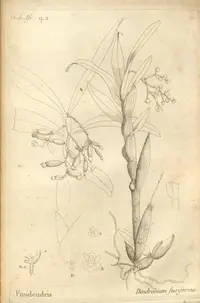
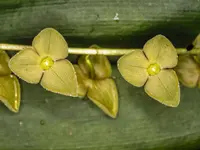
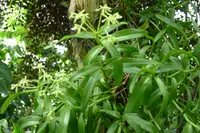
Polystachya fusiformis, often called the Mistforest Snout Orchid, is a small epiphytic orchid that usually grows on trees in humid, montane forests. It forms compact clumps with slender, spindle-shaped pseudobulbs and narrow leaves, producing small, delicate flowers on upright spikes.
This species occurs in parts of tropical Africa, often in cool, misty habitats at higher elevations. Its adaptation to moving air, stable moisture, and moderate light makes it moderately challenging for beginners.
Those who want to learn how to care for Mistforest Snout Orchid should know it prefers bright, filtered light, regular moisture with quick drainage, and consistently mild temperatures, similar to many cloud-forest orchids.

Care Difficulty
Hard Care

Light Preference
Partial Shade

Water Requirements
Keep Soil Moist

Temperature Preference
Tropical / Frost Sensitive

Hardiness Zone
Unknown

Soil Texture
Organic-rich, Peaty, Loamy

Soil pH
Acidic (5.5–6.5)

Soil Drainage
Moist but well-drained

Fertilization
Light (every 4–6 weeks)
Scan your plant to receive care tips personalized for your specific plant
Available on iOS and Android
This orchid prefers bright, gentle light similar to high forest canopies.
This species prefers consistent moisture around the roots without staying saturated.
This orchid grows best in intermediate to warm conditions.
This epiphytic orchid benefits from elevated humidity to maintain healthy leaves and roots.
Polystachya fusiformis prefers an airy, fast-draining orchid substrate rather than dense terrestrial soil.
This species grows well in containers or baskets that mimic its natural epiphytic habit.
This epiphytic orchid benefits from light, consistent feeding during active growth for best flowering and foliage health.
Polystachya fusiformis needs only minimal pruning focused on cleanliness and flower performance.
This orchid prefers a snug container or mount and only occasional repotting when the medium breaks down or roots overcrowd.
Polystachya fusiformis is usually propagated by division rather than from seed in home collections.
This orchid is not frost hardy and needs mild, protected conditions during winter, especially in temperate climates.

Plant Health Check
Not sure what's wrong with your plant? Check your plant's health inside the app.
This orchid is native to cool, misty montane forests of East Africa, where it often grows at higher elevations in Tanzania and neighboring regions on mossy trunks and branches.
It develops distinct spindle- to club-shaped pseudobulbs that store water and nutrients, an adaptation that helps it cope with alternating wet and drier periods in its cloud forest habitat.
The plant remains relatively small, forming tight clumps with multiple short growths, which allows it to occupy limited bark crevices and mossy cushions on host trees.
Lack of flowers usually comes from insufficient light, too little day‑night temperature difference, or nutrient imbalance. Provide brighter but indirect light, cooler nights by 5–10°F, and a weak, balanced orchid fertilizer during active growth.
Keep your plants happy and healthy with plant identification, disease detection, and easy care guidance.