Hairy-lipped Polystachya Care (Polystachya pubescens)

Also known as: Lucky Charm Orchid, Hairylip Snout Orchid, Yellow Tree Orchid
Hairy-lipped Polystachya

About Hairy-lipped Polystachya

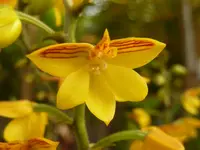
Polystachya pubescens, commonly called hairy-lipped polystachya, is a small epiphytic orchid that typically grows on trees or rocks in humid tropical forests. It forms compact clumps with narrow, upright leaves and short stems. Flowers are usually small but produced in clusters, with a soft hairy texture around the lip that gives the species its common name. Native to parts of tropical Africa, it is adapted to bright, filtered light and regular moisture with good air movement. This orchid suits growers who are comfortable maintaining stable humidity and avoiding waterlogged conditions. With attention to airflow, moisture, and moderate temperatures, it is manageable for intermediate hobbyists who want to learn how to care for Hairy-lipped Polystachya.

Main Plant Requirements

Care Difficulty

Hard Care

Light Preference

Partial Shade

Water Requirements

Keep Soil Moist

Temperature Preference

Tropical / Frost Sensitive

Hardiness Zone

12–13

Soil Texture

Organic-rich, Peaty, Loamy

Soil pH

Acidic (5.5–6.5)

Soil Drainage

Moist but well-drained

Fertilization

Light (every 4–6 weeks)

Get Personalized Care Plan

Scan your plant to receive care tips personalized for your specific plant

Available on iOS and Android

How to Care for the Hairy-lipped Polystachya

This orchid prefers bright, gentle light similar to high, filtered forest canopies.

  • Provide 6–8 hours of bright, filtered light each day, such as dappled shade under trees or 30–50% shade cloth.
  • Allow brief early morning sun but protect Hairy-lipped Polystachya from direct midday and afternoon sun to prevent leaf scorch and yellowing.
  • In winter or overcast conditions, move plants to a brighter position, watching for darker, soft leaves as a sign of insufficient light.

This species prefers evenly moist conditions with excellent drainage and air around the roots.

  • Water when the top 2–3 cm of the medium feels just barely dry, using thorough soakings rather than light splashes.
  • Reduce watering in cooler seasons, but never let Polystachya pubescens stay completely dry for more than a short time.
  • Watch for yellow, limp, or blackened roots as signs of overwatering, and wrinkled, drooping pseudobulbs as a sign of underwatering.

This orchid grows best in mild, stable temperatures typical of warm to intermediate climates.

  • Aim for 65–80°F (18–27°C) during active growth, with a slight nighttime drop of 5–10°F (3–5°C).
  • Avoid temperatures below 50°F (10°C); prolonged exposure near this level slows growth and increases risk of rot and cold damage.
  • The plant tolerates brief heat up to about 90°F (32°C) if shaded and well hydrated, but does poorly in frost or hot, stagnant air.

This orchid prefers elevated humidity to maintain healthy leaf and root growth.

  • Aim for 60–80% humidity, as Hairy-lipped Polystachya reacts poorly to extended periods below 40%.
  • Watch for shriveling pseudobulbs, crispy root tips, or dull, folding leaves as signs of humidity stress.
  • Increase humidity with a nearby humidifier, grouped plants, or a pebble tray that allows airflow around roots.

Polystachya pubescens grows best in a loose, airy, bark-based medium that drains rapidly.

  • Use a fine to medium orchid mix of bark, perlite, and a small amount of sphagnum moss to balance moisture and airflow.
  • Ensure very fast drainage; water should run through within seconds, leaving roots moist but never submerged.
  • Aim for slightly acidic to neutral conditions, roughly pH 5.5–7.0, which supports nutrient uptake and root health.
  • Avoid dense potting soil, heavy peat, or compacted mixes that stay wet and promote root rot.

This species is well suited to container culture, including small orchid pots or baskets.

  • Choose a snug pot that just fits the root mass, which helps the medium dry evenly and reduces stagnant moisture zones.
  • Select slotted or netted orchid containers to increase side aeration, especially in humid growing spaces.
  • Use a heavier pot material or add weight if the plant becomes top-heavy, to prevent tipping when the medium is very dry.

This orchid benefits from light feeding, as Hairy-lipped Polystachya naturally grows on nutrient-poor substrates.

  • Use a balanced orchid fertilizer (roughly 20-20-20 NPK) or similar, formulated for epiphytes.
  • Feed every 2–3 weeks during active growth with solution diluted to 1/4–1/2 the label strength.
  • Rinse the potting medium with plain water monthly to reduce salt buildup.
  • Stop or reduce feeding to once every 4–6 weeks at very weak strength in winter or cool rest periods.

Pruning needs for Polystachya pubescens are minimal and mainly hygienic.

  • Best timing is right after flowering, when new growths are visible.
  • Remove only dead, dried flower spikes and obviously dead or diseased pseudobulbs or leaves.
  • Use fine, sharp scissors or pruning snips sterilized with alcohol before each cut.
  • Avoid cutting green pseudobulbs, as these store energy and support future flowering.

This species is usually grown mounted or in small orchid pots and dislikes frequent disturbance.

  • Repot or remount every 2–3 years, or when roots circle tightly, medium breaks down, or growth slows.
  • Choose late winter to early spring, just before strong new root growth starts.
  • Use a very free-draining medium such as fine bark with perlite or mount on cork or hardwood.
  • Moisten roots first, handle them gently, and keep light and humidity high but watering slightly reduced for 1–2 weeks to limit stress.

Propagation of Polystachya pubescens is usually done on a small scale by division.

  • Divide mature plants in late winter or early spring, when new roots are starting.
  • Ensure each division has at least 3–4 healthy pseudobulbs and active buds.
  • Pot divisions in a similar fine orchid mix and keep humidity around 60–80% with gentle airflow.
  • Seed propagation is highly specialized and typically requires sterile laboratory conditions.

Winter care is important, as this orchid is not tolerant of prolonged cold or frost.

  • Maintain indoor or greenhouse temperatures around 60–70°F and avoid drops below 50°F.
  • For container plants, move them indoors or into a protected greenhouse before the first frost.
  • Reduce watering slightly in cooler months, keeping the medium just barely moist, not wet.
  • Ensure good air movement and bright, indirect light to prevent rot in cool, damp conditions.

Care Tips

Mounting technique

Grow this species on cork bark or hardwood mounts with a thin pad of long-fiber sphagnum so roots dry quickly yet can be rehydrated thoroughly by soaking the mount for 10–15 minutes when it becomes light and dry.

Airflow management

Position the plant where it receives gentle, continuous air movement from an oscillating fan to reduce fungal issues on the fine root system and to help foliage dry promptly after misting.

Targeted root inspection

Once or twice a year, briefly remove the plant from its mount or basket to inspect roots, trimming only clearly dead, hollow, or mushy roots and leaving firm, silvery or green roots untouched to avoid growth setbacks.

Bloom spike support

Use thin bamboo skewers or orchid clips to support tall, slender inflorescences so developing flowers stay upright and are not damaged by air movement or accidental bumps.

Seasonal watering shift

In late autumn, slightly extend the dry interval between soakings and reduce fertilizer frequency to mimic a drier rest period, then resume more frequent watering and feeding when new roots and shoots appear, which supports more reliable flowering when caring for Hairy-lipped Polystachya.

Common Pests and Diseases

Scale insects

This pest feeds on orchid sap, causing yellowing, stunted growth, and sticky honeydew on leaves and pseudobulbs. Symptoms include small, dome-shaped bumps along leaf midribs and sheaths that are hard to remove with a finger.

Solution

Physically remove adults with a cotton swab dipped in isopropyl alcohol, then wash the plant under a gentle lukewarm shower to dislodge crawlers. Improve air movement, avoid overfertilizing with nitrogen, and repeat alcohol swabs weekly until no new scale appears; in heavier infestations, use a labeled systematic insecticide safe for orchids, following directions carefully.

Spider mites

These insects thrive on Polystachya foliage in warm, dry air, causing fine stippling, dull leaves, and delicate webbing on the undersides. Symptoms include bronzing or silvery patches that start near the leaf tips and edges.

Solution

Increase humidity, rinse foliage thoroughly under a gentle shower, and wipe leaf undersides with a soft damp cloth to remove mites and webbing. For persistent problems, apply a miticide or a horticultural oil labeled for orchids, repeating treatments as directed while maintaining stronger air circulation around the plant.

Soft rot (Erwinia)

This disease attacks pseudobulbs and leaf bases, leading to rapidly spreading, foul-smelling, water-soaked tissue. Symptoms include collapsed, mushy areas that turn brown and can destroy the plant within days if unchecked.

Solution

Immediately cut away all affected tissue with a sterile blade, cutting well into firm, healthy tissue, and dust or dab the wounds with powdered sulfur or cinnamon to dry them. Keep the plant much drier at the base, increase air movement, avoid water sitting in leaf axils, and disinfect tools and benches to prevent spread to other orchids.

Leaf spot fungus

This disease causes small, dark, often round to irregular spots on Polystachya leaves, sometimes with yellow halos. Symptoms include gradual coalescing of spots and premature leaf drop in poorly ventilated, constantly damp conditions.

Solution

Remove and discard heavily spotted leaves, then improve spacing and airflow so foliage dries within a few hours after watering. Water in the morning at the base, keep leaves as dry as possible, and apply a broad-spectrum fungicide labeled for orchids if new spots continue to appear.

Mealybugs

This pest hides in leaf axils, around pseudobulb bases, and among roots, sucking sap and excreting honeydew that can lead to sooty mold. Symptoms include cottony white clusters, distorted new growth, and declining vigor despite normal watering and light, which are key signs in Polystachya pubescens plant care.

Solution

Isolate the plant, then dab visible clusters with a cotton swab dipped in isopropyl alcohol and rinse the plant thoroughly, including the root zone if mealybugs are present in the medium. Repeat inspections and alcohol treatments weekly, refresh old potting mix if the roots are heavily infested, and consider a systemic insecticide labeled for ornamental orchids if the infestation persists across several weeks.

Interesting Facts

Epiphytic forest specialist

This species naturally grows as an epiphyte on tree trunks and branches in humid African montane forests, anchoring to bark rather than rooting in soil.

Fine hairy structures

The plant bears characteristic fine hairs on parts of its stems and floral structures, a feature that inspired the common name hairy-lipped polystachya and helps distinguish it from closely related species.

Multi-flowered inflorescences

Its flower spikes typically carry many small, closely spaced blossoms at once, creating dense inflorescences that are attractive to small insect pollinators in its native habitat.

FAQs about Hairy-lipped Polystachya

Lack of blooms often comes from insufficient light intensity, too little day–night temperature difference, or nutrient imbalance. Provide bright, filtered light, slightly cooler nights, and a balanced orchid fertilizer. Avoid frequent repotting, which can delay flowering for a season.

Grow Healthy Plants with Botan Care

Keep your plants happy and healthy with plant identification, disease detection, and easy care guidance.

Botan plant care app — identify plants on mobile

Explore More Plants