

Indian beech tree Identification (Pongamia pinnata)

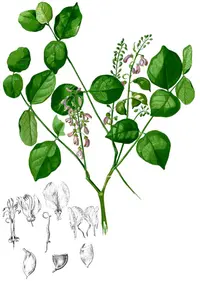
To recognize Indian beech tree, check for alternate compound leaves with 5 to 7 broad, oval leaflets, usually 2 to 4 inches (5 to 10 cm) long, on a single central stalk.

It also shows a short trunk with a wide, spreading crown and hanging clusters of pea-like flowers with a curved upper petal.

Pongamia pinnata Identification

Identify a Plant by Photo

Not sure about your plant ID? Upload a photo and check it with Botan.

Clear images work best. Avoid photos taken too close or too far away

  • 1 free identification
  • No sign-up
  • 30,000+ plants in database

Check the leaf pattern, flower form, and pod shape on Pongamia pinnata.

  • Leaves are alternate and pinnate, with 5-7 smooth, oval leaflets on one stalk.
  • Leaflets are thick, glossy, and often broader toward the tip, with a pointed end.
  • Flowers sit in short hanging clusters and look pea-like, with 5 petals, usually white to pale pink or lilac.
  • Pods are flat, thick, and slightly curved, about 1.5-3 inches (4-8 cm) long, usually holding one seed.

Flat pods and few broad leaflets are especially useful when no flowers are present.

Indian beech tree shows clear visual shifts from seedling leaves to woody fruiting branches.

  • Seedling: Seedlings show a thin green stem and simple first leaves, then quickly shift to compound leaves with broad, smooth-edged leaflets.
  • Young plant: Young plants form an upright sapling with smoother gray-brown bark and pinnate leaves carrying 5-7 glossy leaflets, unlike the seedling’s simpler early foliage.
  • Flowering stage: Flowering branches carry short hanging clusters of pea-like flowers, pale pink to white, set among mature leaves rather than at bare shoot tips.
  • Fruiting stage: After flowering, the clusters are replaced by thick, flattened pods about 2 inches (5 cm) long, clearly changing the branch outline and weight distribution.

In spring to early summer, Pongamia pinnata becomes easier to spot when clusters of small pale pink to white, pea-like flowers appear against the glossy green leaflets. Later, flat seed pods develop and remain visible as they mature and dry. In areas with a dry season, the crown may look briefly thinner when some leaves are shed before fresh growth returns.

A few legume trees can be mistaken for Indian beech tree at a glance.

queen's crape-myrtle(Gliricidia sepium)

Both are medium trees with pinnate leaves and pea-type flowers. Gliricidia usually has more, narrower leaflets and often leafless flowering branches; Pongamia pinnata has broader, shinier leaflets and denser evergreen foliage.

bead tree(Melia azedarach)

Young trees can seem similar because both have compound leaves and a rounded crown. Melia leaves are usually twice compound, giving a finer texture, and its fruits are round yellow berries, not flat beanlike pods.

Pongamia pinnata is native from the Indian subcontinent through Southeast Asia to northern Australia. Its range is useful because it is most often encountered in tropical and subtropical coastal and lowland settings across this belt. In the wild it grows along riverbanks, estuaries, backwaters, and coastal margins, often in tidal or seasonally flooded places. Finding a medium tree in these habitats helps separate it from inland dry-forest legumes.

  • Seed toxicity: Seeds are the main concern. They contain bioactive compounds and are considered poisonous if eaten. This is an ingestion risk for humans and pets.
  • Oil and plant contact: Pongamia oil and crushed seed material can irritate skin in some people. This is a skin-contact concern for humans who handle seeds or oil directly.

Confirm the Species with Botan

Use a photo to identify or verify the plant, which helps avoid mix-ups with similar species.

FAQ

Fruits develop after flowering and are often visible for months as thick, flattened pods. Each pod usually holds one seed and turns from green to tan or brown as it matures.

More Plant Identification Guides

Identify First. Learn What Comes Next.

Use Botan to identify a plant from a photo, then get species-specific care information, safety notes, and common problems.

Botan app identifying a plant from a photo
Best Time to Mow Lawn – A Complete Guide

5 min read · 10 Aug 2026

Best Time to Mow Lawn – A Complete Guide

Explore when to mow your lawn for its health and a pleasant green color. Find out the best time for this task during the summer heat, and follow practical tips for correctly cutting the grass, and learn common mistakes to avoid.

Plant Care
Best Time to Mow Lawn – A Complete Guide
How to Mulch in the Fall and When to Wait Until Spring

5 min read · 12 Nov 2026

How to Mulch in the Fall and When to Wait Until Spring

In the fall, mulch gives the roots of trees and shrubs insulation and more stable conditions through winter. In the spring, it mainly suppresses weeds and keeps moisture in the soil during the growing season.

Beginner Guides
How to Mulch in the Fall and When to Wait Until Spring
What Do Plants Need to Grow – 5 Things Every Greenery Can't Live Without

8 min read · 31 Jul 2026

What Do Plants Need to Grow – 5 Things Every Greenery Can't Live Without

To keep plants healthy and thriving, provide the right balance of light, humidity, nutrients, airflow, and quality soil. This guide covers the essentials of year-round plant care.

Beginner Guides
What Do Plants Need to Grow – 5 Things Every Greenery Can't Live Without