
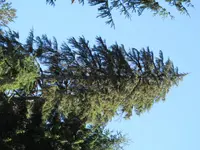



Sago palm Identification (Cycas revoluta)

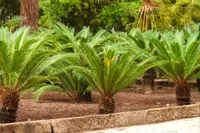
Recognize Sago palm by its stiff, feather-like leaves forming a dense rosette at the top of a thick, usually unbranched trunk. Each leaf has many narrow leaflets set in opposite rows, and the leaf stalk often carries short spines near the base.

The trunk is cylindrical and clothed with old leaf bases.

Cycas revoluta Identification

Scan to Confirm Sago palm

Upload a clear photo to check your plant identification with Botan.

Clear images work best. Avoid photos taken too close or too far away

Use these visible traits to check for Cycas revoluta.

  • Leaves form a dense, symmetrical rosette at the top of a single stout trunk.
  • Each leaf is stiff, feather-like, and usually about 3-5 feet (0.9-1.5 m) long.
  • Leaflets are narrow, glossy, and set in many pairs along the leaf stalk, often around 100 or more per leaf.
  • Leaflet edges roll under slightly, and each leaflet tapers to a sharp point.
  • The trunk is rough and shaggy with old leaf-base scars, often thick and unbranched.

A central cone is also a useful visible clue when present.

Cycas revoluta shows clear age-related changes in form, trunk development, and reproductive structures.

  • Seedling: Seedlings form a low rosette of soft, once-pinnate leaves from a swollen base, with no visible trunk and fewer, narrower leaflets than older plants.
  • Young plant: Young plants keep a symmetrical crown but begin producing stiff, glossy leaves up to 3 feet (0.9 m) long above a short, thickening stem.
  • Mature plant: Mature plants show a distinct trunk topped by a dense crown; old leaf bases create a rough, armored surface unlike the smoother juvenile base.
  • Fruiting stage: Female plants carry large orange to red seeds in a woolly center, replacing the simple crown appearance seen in non-reproductive plants.

In late spring to early summer, Cycas revoluta often produces a fresh flush of leaves from the crown. The new fronds emerge soft, lighter green, and tightly packed before expanding into the stiff, glossy rosette typical of the species. On mature plants, reproductive structures may also become visible in warm months. Male plants form an upright cone, while females develop a rounded, woolly structure with exposed orange seeds later on.

Several cycads and one palm are often mistaken for Sago palm.

cardboard palm(Zamia furfuracea)

Both form a stiff rosette of pinnate leaves. Cardboard palm has broader, oval leaflets with a thick, matte texture; Cycas revoluta has many narrow, glossy leaflets.

queen sago(Cycas circinalis)

This cycad has the same trunked, palm-like outline. Its leaves are larger and arching, often 5 to 8 feet (1.5 to 2.4 m), with flatter leaflets instead of the strongly revolute margins.

coontie(Zamia integrifolia)

Young plants can resemble a trunkless cycad. Coontie stays low, usually without an above-ground trunk, and its leaflets are fewer, wider, and not curled under at the edges.

Cycas revoluta is native to southern Japan, especially the Ryukyu Islands and parts of Kyushu. In the wild it occurs on coastal slopes, rocky ground, and open scrub or light woodland, often near the sea. That range helps with identification because a cycad reported as naturally growing in Japan, rather than tropical mainland Asia or the Americas, points more strongly to Cycas revoluta. Its frequent association with exposed coastal and rocky sites is also a useful clue.

  • All parts are toxic: Cycas revoluta is poisonous to humans and pets if eaten. Seeds are especially dangerous, but leaves and roots also contain toxins.
  • Pet poisoning risk: Dogs are often seriously affected after ingesting seeds or leaves. The concern is ingestion, not routine skin contact.

Does Your Plant Match?

Upload a photo to Botan to identify it or confirm the name, which helps avoid mix-ups with similar-looking plants.

FAQ

The quickest clue is the stiff rosette of glossy, dark green fronds emerging from a thick, rough trunk. Each frond carries many narrow leaflets in two ranks, giving a very symmetrical, formal look.

More Plant Identification Guides

Find Out What Plant It Is

Use Botan to identify it from a photo, then review plant details, care information, and common problems.

Botan app identifying a plant from a photo
12 Best Cold-Hardy Vegetables for Cold Weather

7 min read · 13 Oct 2026

12 Best Cold-Hardy Vegetables for Cold Weather

Cold-hardy vegetables can keep a garden productive through chilly fall, winter, and early spring weather. This guide covers 12 reliable crops, their frost tolerance, and practical growing tips for better cold-season harvests.

Plant Recommendations
12 Best Cold-Hardy Vegetables for Cold Weather
12 Best Plants That Repel Spiders For Your Home and Garden

8 min read · 24 Jul 2026

12 Best Plants That Repel Spiders For Your Home and Garden

Spiders constantly appear in places you don't want them. A few common plants can help repel them using scent alone. Here are 12 options suitable for both indoors and outdoors, plus care tips for each.

Plant Recommendations
12 Best Plants That Repel Spiders For Your Home and Garden
8 Glow-in-the-Dark Plants and Fungi That Really Exist

8 min read · 6 Nov 2026

8 Glow-in-the-Dark Plants and Fungi That Really Exist

Plants that glow in the dusk really exist. Some of them produce their own light, while others need UV exposure or special treatments. Explore eight fascinating examples, including glowing petunias, bioluminescent mushrooms, fluorescent flowers, and experimental succulents.

Plant Recommendations
8 Glow-in-the-Dark Plants and Fungi That Really Exist