



Cactus Identification (Disocactus phyllanthoides)

Recognize Disocactus phyllanthoides by its flattened, leaf-like stems made of linked segments with shallow scalloped edges and a trailing, pendulous habit. Segments are usually about 1 to 2 inches (2.5 to 5 cm) wide.

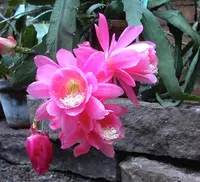
Another strong cue is its large, funnel-shaped pink flowers that emerge from the stem margins rather than from a woody trunk.

Disocactus phyllanthoides Identification

Is This Cactus?

Check your plant ID by uploading a clear photo to Botan.

Clear images work best. Avoid photos taken too close or too far away

Check the flat, hanging stems and large flowers first on Disocactus phyllanthoides.

  • Stems are flattened into leaf-like segments rather than cylindrical pads.
  • Segments hang or arch, with scalloped to shallowly toothed edges and a noticeable midrib.
  • Most segments are about 1 to 2 inches (2.5 to 5 cm) wide and branch from older stems.
  • Flowers are funnel-shaped, bright pink to rose, and roughly 3 to 4 inches (8 to 10 cm) across.
  • Blooms appear from the stem edges, not from a central crown or trunk.

Look for a cascading plant made of flat stem segments rather than true leaves.

Disocactus phyllanthoides shows clear stage-based changes in stem shape, branching, and flowering habit.

  • Juvenile plant: Early growth is mostly narrow, flattened stem segments with small scallops. Branching is limited, and the plant hangs less than older specimens.
  • Young plant: As it develops, stems broaden into leaf-like segments about 8-16 inches (20-40 cm) long. Branches become more pendent and form layered, arching sprays.
  • Mature plant: Older plants show a fuller cascading habit with many flattened segments arising from older basal stems. The base looks woodier, and branch systems appear denser.
  • Flowering stage: At this stage, large pink flowers appear from segment margins and tips. Blooms are showier than the vegetative stems and make mature plants easier to confirm.

The clearest seasonal clue in Disocactus phyllanthoides is flowering. In spring, and sometimes into early summer, the flat, hanging stems carry large pink blooms that stand out well beyond the stem edges. Outside the flowering period, the plant usually keeps the same flattened green stems year-round. It does not develop a deciduous bare-season look that would add strong identification value.

Several hanging epiphytic cacti can be mistaken for Disocactus phyllanthoides.

orchid cactus(Disocactus ackermannii)

Often confused because both have flattened, pendulous stems and large pink to red flowers. D. ackermannii usually has narrower stem segments with more pointed lobes, and its flowers are typically more starry and bright scarlet-red than the broader, pinker blooms of D. phyllanthoides.

queen of the night(Epiphyllum oxypetalum)

This species also has flat, leaflike stems, so sterile plants can mislead. It is usually more upright at first, with broader main stems and long, white, night-opening flowers, not the pink to rose daytime flowers associated with this plant.

Disocactus phyllanthoides is native to eastern and southeastern Mexico. It is found in moist tropical forest, including cloud forest, where it typically grows as an epiphyte, meaning on trees rather than rooted in soil. That setting helps with identification because this species belongs to the forest-dwelling epiphytic cacti, not the desert cacti. A plant said to come from Mexican rain or cloud forest fits this species better than one linked to dry scrub or rocky desert slopes.

Scan. Check. Confirm.

Use Botan to compare a photo with likely matches and confirm the identification before you label or buy the plant.

FAQ

The clearest feature is its flattened, hanging stem segments that look leaf-like. Margins are scalloped or shallowly lobed, and mature plants carry large, funnel-shaped pink flowers from the segment edges, useful for identifying Cactus.

Everything About Cactus

More Plant Identification Guides

From Plant ID to Plant Info

Identify a plant from a photo with Botan, then see plant details, care information, and common problems for that species.

Botan app identifying a plant from a photo
How to Clean Plant Leaves: A Simple Care Guide

6 min read · 4 Aug 2026

How to Clean Plant Leaves: A Simple Care Guide

Dusty leaves look dull and don't absorb light well. Below, you'll find simple ways to clean them, which tools are truly effective, how often you should do it, and what causes damage.

Beginner Guides
How to Clean Plant Leaves: A Simple Care Guide
12 Most Wanted Rare Houseplants to Grow at Home

6 min read · 21 Sept 2026

12 Most Wanted Rare Houseplants to Grow at Home

Rare houseplants can turn an ordinary corner in your apartment into a living botanical collection. This guide covers 12 most admired picks, what makes them special, and how to grow them successfully at home.

Plant Recommendations
12 Most Wanted Rare Houseplants to Grow at Home
Rice Water for Plants – Which Plants Love It and How to Make It

8 min read · 14 Jul 2026

Rice Water for Plants – Which Plants Love It and How to Make It

Rice water can be an ideal DIY solution for orchids, roses, or fruiting plants. It supports growth, leaf count, and height. We’ll share how to make and apply it correctly for your plant.

Plant Care
Rice Water for Plants – Which Plants Love It and How to Make It