

eastern cottonwood Identification (Populus deltoides)

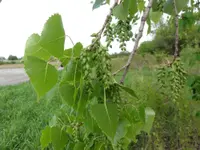
Recognize eastern cottonwood by its broad triangular leaves with coarse teeth and a flattened leaf stalk that lets each leaf hang and twist. Leaves are alternate, not opposite.

Also check the stout trunk with thick, furrowed bark on mature trees and the wide, open crown typical of large specimens.

Populus deltoides Identification

Scan to Confirm eastern cottonwood

Upload a clear photo to check your plant identification with Botan.

Clear images work best. Avoid photos taken too close or too far away

  • 1 free identification
  • No sign-up
  • 30,000+ plants in database

Check eastern cottonwood for a broad crown and large, triangular leaves.

  • Leaves are alternate, roughly triangular to diamond-shaped, usually 3-6 inches (8-15 cm) long, with coarse rounded teeth.
  • Leaf stalks are long and flattened, so the blades often hang and twist sideways.
  • Twigs are thick and stout, with large pointed buds pressed close to them.
  • The trunk is usually massive and straight, with gray bark broken into deep furrows and heavy ridges.

Catkins and cottony seed fluff, when present, are also easy visual clues.

Populus deltoides shows clear visual shifts from juvenile shoots to fruiting adult trees.

  • Juvenile plant: Juvenile shoots often carry unusually large, broad triangular leaves on vigorous upright stems, with a coarser outline than the crown foliage of older trees.
  • Young plant: Young plants form a narrow, fast-rising crown and smooth gray bark, while lower branches remain more evident and the trunk is still relatively slender.
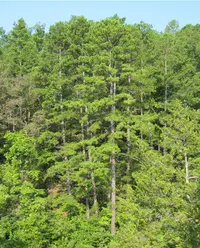
  • Mature plant: Mature trees develop a broad, open crown 50-100 feet (15-30 m) tall, with thick furrowed bark and stout limbs spreading widely from the main trunk.
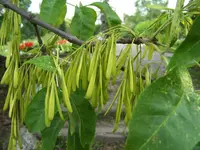
  • Fruiting stage: Fruiting branches bear hanging capsules in clusters; when split open, they release many seeds surrounded by conspicuous white cottony hairs.

In spring, Populus deltoides leafs out with glossy, triangular leaves, and flowers appear as drooping catkins before or with the leaves. Female trees soon develop cottony seed masses that become very noticeable in late spring to early summer. By fall, the foliage turns yellow before dropping. After leaf fall, the broad crown, thick twigs, and deeply furrowed gray bark are easier to see, which helps with winter identification.

A few poplars are regularly mistaken for eastern cottonwood.

black cottonwood(Populus trichocarpa)

Often confused because both are tall cottonwoods with broadly triangular leaves. Black cottonwood usually has leaves with a longer tapering tip and the undersides are paler; its buds are large, sticky, and strongly resin-scented.

Canadian poplar(Populus × canadensis)

This hybrid can look very similar because one parent is Populus deltoides. It is often told apart by more variable leaves, usually less coarsely toothed, and by branch and crown shape that is narrower and more upright in many planted trees.

Populus deltoides is native to much of eastern, central, and southern North America, from southern Canada through the Great Plains to the Gulf Coast. It is most often found on floodplains, along rivers, stream banks, lake margins, and other moist lowlands. Seeing a large poplar in alluvial bottomland is a useful clue that supports identification.

Does Your Plant Match?

Botan can compare a photo to likely matches and help confirm the plant before you rely on the identification.

FAQ

For fast eastern cottonwood identification, check the broad triangular leaves with coarse rounded teeth and a flattened leaf stalk. In wind, the leaves flutter strongly, and mature trees usually show deeply furrowed gray bark.

More Plant Identification Guides

Find Out What Plant It Is

Use Botan to identify a plant from a photo, then review its care information, safety notes, and common problems.

Botan app identifying a plant from a photo
Best Fertilizer for Grass in Summer: How to Choose the Right One

6 min read · 18 Aug 2026

Best Fertilizer for Grass in Summer: How to Choose the Right One

The right fertilizer in summer can make a lawn thrive. The wrong one can damage it. Here, you’ll learn the best NPK ratios by grass type, when and how to apply your formula, and how to recognize the signs of over- or under-fertilizing.

Plant Care
Best Fertilizer for Grass in Summer: How to Choose the Right One
12 Best Plants That Repel Spiders For Your Home and Garden

8 min read · 24 Jul 2026

12 Best Plants That Repel Spiders For Your Home and Garden

Spiders constantly appear in places you don't want them. A few common plants can help repel them using scent alone. Here are 12 options suitable for both indoors and outdoors, plus care tips for each.

Plant Recommendations
12 Best Plants That Repel Spiders For Your Home and Garden
20 Most Popular Fruits Around the World

7 min read · 22 Jul 2026

20 Most Popular Fruits Around the World

Curious which fruits the world actually eats the most? Here's the top-20 by production volume, an overview of what people choose in each region, and a few figures that defy common assumptions.

Plant Recommendations
20 Most Popular Fruits Around the World