Mounting strategy
Use a cork or hardwood mount with a thin layer of long-fiber sphagnum only around the roots, then secure the plant with soft wire or plant tape so new pseudobulbs have space to grow outward and not press against the mount.

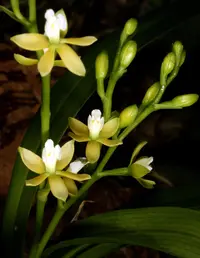
Prosthechea ochracea is a small epiphytic orchid, usually found growing on trees rather than in soil. It forms clustered pseudobulbs topped with narrow, leathery leaves and produces showy, often fragrant flowers in shades of yellow to ochre.
This species is native to cloud forests of Mexico and Central America, where it experiences bright filtered light, regular moisture, and good air movement. In cultivation it is considered moderately easy, provided humidity and airflow are stable and roots never sit in stale, soggy media. Learning how to care for Prosthechea ochracea mainly involves balancing light, moisture, and ventilation to mimic its airy forest habitat.

Care Difficulty
Moderate Care

Light Preference
Bright Indirect Light

Water Requirements
Moderate Water

Temperature Preference
Tropical / Frost Sensitive

Hardiness Zone
Unknown

Soil Texture
Peaty, Organic-rich

Soil pH
Acidic (5.5–6.5)

Soil Drainage
Well-drained

Fertilization
Light (every 4–6 weeks)
Scan your plant to receive care tips personalized for your specific plant
Available on iOS and Android
This orchid prefers bright, indirect light that mimics high tree-branch conditions in the wild.
Watering should balance consistent moisture with fast drainage around the roots.
This species prefers intermediate to warm conditions with a mild day–night temperature drop.
This orchid prefers moderate to high humidity to maintain healthy foliage and roots.
This epiphytic orchid needs a very loose, fast-draining medium rather than standard potting soil.
This species grows well in containers or baskets when drainage and aeration are prioritized.
Feeding supports steady growth and reliable flowering for Prosthechea ochracea in cultivation.
Pruning needs are light and mainly focused on hygiene for Prosthechea ochracea.
Repotting keeps this epiphytic orchid healthy by refreshing the medium and giving roots room.
Division is the most practical method for increasing Prosthechea ochracea in home collections.
This orchid is frost sensitive and needs warm, sheltered conditions in winter.

Plant Health Check
Not sure what's wrong with your plant? Check your plant's health inside the app.
This species is naturally found as a small epiphyte in cool to intermediate cloud forests of Mexico and Central America, often growing on tree branches enveloped in frequent mist and high humidity.
The creamy to yellowish flowers typically release a stronger fragrance in the evening and night, a trait associated with attracting night-active pollinators such as moths.
The species name ochracea refers to the characteristic ochre or yellow-brown tones on the lip and inner parts of the flower, which contrast with the paler petals and sepals.
Lack of flowering usually comes from insufficient light, no marked day–night temperature drop, or overfeeding with high-nitrogen fertilizer. Provide bright but indirect light, a 10–15°F cooler night, and a balanced orchid fertilizer to trigger blooms.
Keep your plants happy and healthy with plant identification, disease detection, and easy care guidance.