

Damson Identification (Prunus insititia)

Recognize Damson by its compact tree form, oval to elliptic leaves with finely toothed edges, and short fruiting spurs that crowd along older twigs. Branches often form a dense, rounded crown rather than long, open shoots.

Flowers are usually borne singly or in pairs on short stalks from the wood, not in long clusters.

Prunus insititia Identification

Check Your Plant ID

Take a photo and use Botan to confirm your plant identification.

Clear images work best. Avoid photos taken too close or too far away

  • 1 free identification
  • No sign-up
  • 30,000+ plants in database

Check the overall form, leaves, flowers, and fruit of Prunus insititia.

  • Usually a small tree with a rounded crown and short trunk, often 10-20 feet (3-6 m) tall.
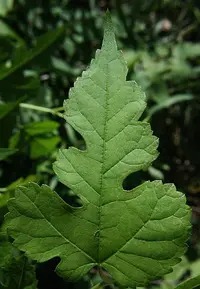
  • Leaves are simple, alternate, oval to elliptic, with fine toothed edges, often about 1.5-3 inches (4-8 cm) long.
  • Flowers are white, with 5 petals, borne singly or in pairs close to the twigs.
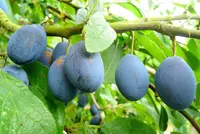
  • Fruits are round to oval drupes, often blue-purple with a pale waxy bloom on the skin.

Fruit shape and the white 5-petaled flowers are especially useful visible clues.

Prunus insititia shows clear visual differences between early growth, flowering, and fruiting stages.

  • Young plant: Young plants are usually shrubby or small-tree shaped, with slender twigs, short side shoots, and relatively larger-looking oval leaves on a compact framework.
  • Mature plant: Mature plants form a denser, broader crown and sturdier trunk, often reaching 10 to 20 feet (3 to 6 m), with more rigid branch structure.
  • Flowering stage: Before leaves fully expand, clusters of white five-petaled flowers line short spur shoots, making the branch pattern easier to see than in leafy stages.
  • Fruiting stage: Damson is easiest to recognize when branches carry rounded to oval purple-blue drupes, about 1 inch (2.5 cm) wide, hanging singly or sparsely clustered.

In spring, Prunus insititia is easier to spot when pale flowers open on bare twigs before or with the first leaves. That brief bloom makes the branch structure and short fruiting spurs more visible. By late summer to early fall, rounded plum fruits become the clearest clue. After leaf drop, the dark twigs and thorny side shoots stand out more plainly.

A few close relatives are regularly mistaken for Damson.

sloe(Prunus spinosa)

Both are thorny Prunus with white spring flowers and small blue-purple fruits. Sloe is usually a dense suckering shrub, often 3-10 feet (0.9-3 m), with sharper spines and fruits around 0.5 inch (1.3 cm); Damson is more often a small tree with larger plums.

European plum(Prunus domestica)

It shares similar leaves, blossom, and plum-like fruit, so orchard seedlings can be confusing. European plum typically grows as a less spiny tree and bears larger fruits, often over 1.5 inches (4 cm), while Damson fruit is smaller and the plant is commonly thornier.

  • Pits and leaves: The seed inside the pit, plus leaves and wilted foliage, contain cyanogenic compounds. If chewed or eaten, they can release cyanide and are harmful to humans and pets.
  • Fruit handling context: The flesh is not the main concern, but the pit is. Risk relates to ingestion rather than skin contact, especially for children and dogs that may swallow whole fruits.

Confirm It from a Photo

Use Botan to identify or verify the plant from an image, helping avoid mix-ups with similar species.

FAQ

Flowers are usually borne singly or in pairs on short stalks along older twigs before or with the leaves. Each bloom is white and about 1 inch (2.5 cm) across, a useful point when identifying Damson.

More Plant Identification Guides

Know What Plant You Have

Identify it from a photo with Botan, then review care information, safety notes, and common problems for that species.

Botan app identifying a plant from a photo
10 Easy Garden Flowers to Grow

8 min read · 10 Sept 2026

10 Easy Garden Flowers to Grow

Discover 10 garden flowers that require minimal care. Learn which characteristics make plants easy to grow and follow tips on how to create a beautiful corner from beginner-friendly blooms on your property.

Beginner Guides
10 Easy Garden Flowers to Grow
Dill Companion Plants – What to Grow Next to Dill

9 min read · 17 Jul 2026

Dill Companion Plants – What to Grow Next to Dill

Dill is an easy-to-grow plant that gets along well with many vegetables. This guide describes 15 plants that can be planted alongside it, a few to avoid, and mistakes that can quietly sabotage the entire process.

Plant Recommendations
Dill Companion Plants – What to Grow Next to Dill
How to Clean Plant Leaves: A Simple Care Guide

6 min read · 4 Aug 2026

How to Clean Plant Leaves: A Simple Care Guide

Dusty leaves look dull and don't absorb light well. Below, you'll find simple ways to clean them, which tools are truly effective, how often you should do it, and what causes damage.

Beginner Guides
How to Clean Plant Leaves: A Simple Care Guide