Early staking
Install a sturdy stake when the plant is still small and loosely tie the trunk in 2–3 places to keep the narrow, upright form stable in wind as it gains height.

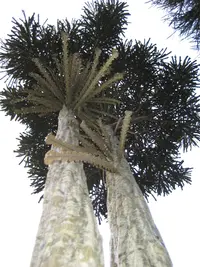
Toothed lancewood, Pseudopanax ferox, is an evergreen shrub or small tree from New Zealand, valued for its unusual, narrow, sharply toothed juvenile leaves. It grows slowly and often has a sparse, architectural form that suits modern gardens and collectors of unusual species.
In its native habitat it occurs in coastal and lowland forest, where conditions are mild and relatively moist. The plant can be somewhat demanding, as it dislikes extreme cold, hot drying winds, and waterlogged soil.
For gardeners who learn how to care for Toothed lancewood, it can be a long-lived feature plant. It prefers bright light with some protection from harsh sun, free-draining soil, and steady but not excessive moisture.

Care Difficulty
Moderate Care

Light Preference
Full Sun

Water Requirements
Moderate Water

Temperature Preference
Warm Climate

Hardiness Zone
9–11

Soil Texture
Sandy, Loamy, Organic-rich

Soil pH
Acidic (5.5–6.5), Slightly acidic (6.5–7.0)

Soil Drainage
Well-drained

Fertilization
Minimal (feed rarely)
Scan your plant to receive care tips personalized for your specific plant
Available on iOS and Android
This New Zealand native shrub or small tree prefers bright outdoor conditions with some protection from harsh extremes.
This species prefers evenly moist but not saturated soil, with brief drying between waterings.
This species prefers mild, coastal-type climates without temperature extremes.
This species tolerates a wide humidity range but benefits from moderately moist air.
This plant prefers sharply drained, moderately fertile soil that does not stay wet.
This species is suitable for container growing, especially in cooler or exposed climates.
This New Zealand native grows slowly and needs only light feeding in containers or poor soils.
Pseudopanax ferox needs minimal pruning and is usually shaped by its natural architectural growth.
This species is often grown in the ground, so focus on careful transplanting rather than frequent repotting.
Pseudopanax ferox is slow and somewhat challenging to propagate, so it is not commonly multiplied at home.
This tree is moderately cold hardy but benefits from some winter attention in colder regions.

Plant Health Check
Not sure what's wrong with your plant? Check your plant's health inside the app.
Young plants can spend decades as a narrow, unbranched pole with long, stiff, downward-pointing, toothed leaves, an unusual life stage among woody plants and characteristic of some New Zealand trees.
After many years the plant changes completely, losing the spiky juvenile crown and developing a branched, small-treed form with much broader, nearly toothless leaves.
This species occurs naturally only in New Zealand, mainly in drier lowland forests and scrub on the eastern side of the North and South Islands, where it is part of the native coastal and lowland flora.

The species name ferox, meaning fierce in Latin, refers to the harsh, rigid, toothed leaves of the juvenile form, which are thought to discourage browsing by native herbivores such as the now-extinct moa.
Growth is generally slow to moderate, especially in the juvenile stage. In suitable outdoor conditions, it may add 10–20 cm of height per year, then gradually speed up as it develops a stronger trunk and canopy.
Keep your plants happy and healthy with plant identification, disease detection, and easy care guidance.