


Use clean tools
Disinfect knives, scalpels, and any substrate-cutting tools with 70% isopropyl alcohol before each use to reduce contamination of your cultures and fruiting blocks.

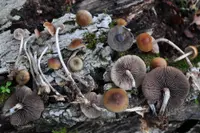
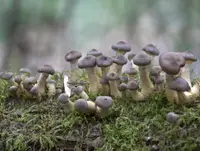
Blue-foot, Psilocybe caerulipes, is a small wood-loving mushroom rather than a leafy houseplant. It forms clusters of slender stems with brownish caps that bruise blue when handled.
In nature it occurs in eastern North America, typically on decaying hardwood logs or buried wood in moist forests. It is considered uncommon and can be difficult to find.
Because it needs consistently cool, humid, and clean conditions with the right woody substrate, it is not easy to cultivate indoors. Only experienced growers should attempt to care for Blue-foot, as it is sensitive to changes in moisture, airflow, and contamination.

Care Difficulty
Hard Care

Light Preference
Shade

Water Requirements
Keep Soil Moist

Temperature Preference
Cool Climate

Hardiness Zone
Unknown

Soil Texture
Loamy, Silty, Organic-rich

Soil pH
Acidic (5.5–6.5)

Soil Drainage
Moist but well-drained

Fertilization
Minimal (feed rarely)
Scan your plant to receive care tips personalized for your specific plant
Available on iOS and Android
This wood-inhabiting fungus prefers low to moderate natural light similar to a shaded forest floor.
Moisture management for this wood-loving fungus focuses on evenly damp, not saturated, substrate.
This species performs best in cool to mild conditions typical of shaded, temperate woodlands.
This wood-inhabiting mushroom requires consistently high humidity to form and sustain fruiting bodies.
Psilocybe caerulipes fruits on moist, decaying hardwood rather than true soil, so a wood-based, aerated substrate is essential.
This species can be grown in containers but performs best when the container imitates a shallow, woody forest-floor environment.
Psilocybe caerulipes naturally fruits on decaying wood and typically does not need added fertilizer in cultivation.
Psilocybe caerulipes does not require pruning, since the visible mushrooms are only temporary fruiting bodies of an underground mycelium network.
In cultivation, Psilocybe caerulipes is usually managed by refreshing its substrate rather than classic repotting.
Propagation of Psilocybe caerulipes is technically demanding and usually handled by experienced growers using sterile methods.
Outdoor patches of Psilocybe caerulipes in suitable climates are generally cold hardy and need minimal winter intervention.

Plant Health Check
Not sure what's wrong with your plant? Check your plant's health inside the app.
This species is known for its strong blue staining reaction on the stem and cap when bruised, caused by the oxidation of psilocin and related indole compounds in the flesh.
It is a saprotrophic fungus that primarily colonizes well-decayed hardwood, especially beech in mixed deciduous forests, playing a role in breaking down lignin-rich wood.
The species has a scattered distribution in eastern North America, often reported from the Great Lakes region to the Appalachian area, but usually in small, localized populations rather than widespread flushes.

The species name caerulipes literally means blue-foot in Latinized form, referring to the characteristic bluish coloration at the base of the stem that appears naturally or becomes more pronounced when the tissue is handled or damaged.
This species contains psychoactive compounds and should be treated as toxic. Ingestion can cause neurological symptoms, nausea, and distress, especially in children and pets. Avoid intentional consumption and keep it out of reach of animals and unsupervised minors.
Keep your plants happy and healthy with plant identification, disease detection, and easy care guidance.

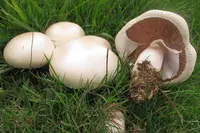
Horse Mushroom
Agaricus arvensis
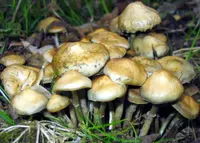
psychedelic ovoid mushroom
Psilocybe ovoideocystidiata
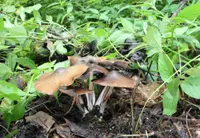
landslide mushroom
Psilocybe caerulescens
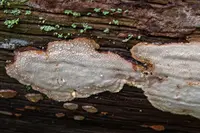
Anthoporia
Anthoporia albobrunnea
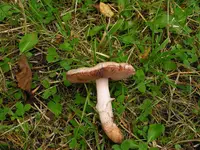
Scaly Wood Mushroom
Agaricus langei
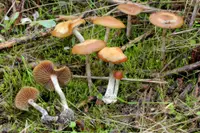
wavy cap
Psilocybe cyanescens
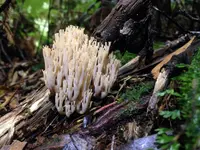
Artomyces austropiperatus
Artomyces austropiperatus
mullet honey fungus
Armillaria cepistipes