
Blue-foot Identification (Psilocybe caerulipes)

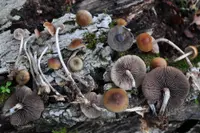
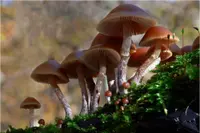
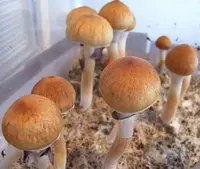
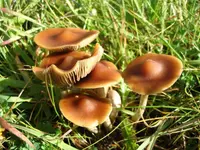
To recognize Psilocybe caerulipes, look for a small brown cap about 1–3 inches (2.5–7.5 cm) wide, a slender stem roughly 2–5 inches (5–13 cm) long, and strong blue bruising on the stem base.

It often appears in scattered groups, with attached gray to purplish gills beneath the cap.

Psilocybe caerulipes Identification

Identify a Plant by Photo

Not sure about your plant ID? Upload a photo and check it with Botan.

Clear images work best. Avoid photos taken too close or too far away

Check Psilocybe caerulipes for a small brown cap, crowded gills, and a slender stem.

  • Cap usually convex to bell-shaped, often with a low central bump, about 1-3 inches (2.5-7.5 cm) across.
  • Gills are close together and attached to the stem, starting pale and becoming dark purplish brown.
  • Stem is thin and fairly even, often a little wider at the base, without a ring.
  • Bruised areas on the stem or cap can show blue to blue-green staining.

Use several traits together, especially the small cap, crowded darkening gills, ringless stem, and blue bruising.

Psilocybe caerulipes shows clear age-related changes in cap shape, stem proportions, and veil remnants.

  • Young plant: Very young mushrooms appear as small buttons, with a strongly convex to bell-shaped cap and inrolled margin; the slender stem is relatively short and thick-looking.
  • Mature plant: As the fruit body expands, the cap becomes broadly convex to nearly flat, often 1-3 inches (2.5-7.5 cm) across, while the stem looks longer and more delicate.
  • Fruiting stage: In developed fruiting bodies, the partial veil has broken, leaving no lasting ring; exposed gills darken as spores mature, and bruised areas may show blue tones.

Blue-foot is most likely to be seen from late summer into fall, when fruiting bodies appear on decaying hardwood. Fresh caps are moist and caramel to chestnut brown, then fade paler as they dry. Bruising blue often becomes more visible with handling or age during the fruiting period, which can help confirm identification in the field.

Psilocybe caerulipes is native to eastern North America. Reliable records place it in hardwood-rich parts of the eastern United States and southeastern Canada, including the Appalachians, Great Lakes region, and nearby forests. Habitat is a useful ID clue because this species is typically found on decaying hardwood debris, wood chips, or well-rotted logs in moist woodland settings, often near stream valleys or shaded trails. Finding a similar mushroom in open grassland or on dung would point away from P. caerulipes.

  • Psychoactive ingestion risk: The fruiting body contains psilocybin and related compounds. Ingestion can intoxicate humans; pets are also at risk if they eat mushrooms.
  • Serious misidentification risk: Wrong ID can be dangerous because small brown woodland mushrooms include deadly Galerina marginata. A key visible difference is Galerina’s rusty-brown spore print, while Psilocybe caerulipes has a dark purplish-brown spore print.

Confirm It from a Photo

Botan can compare your photo and help confirm the species, which is useful when details are unclear or lookalikes make identification harder.

FAQ

Fruiting is usually seen from late summer into fall. In much of its range, mushrooms appear after warm, wet weather, often from August through October, sometimes extending into November in milder conditions.

More Plant Identification Guides

One Photo. More About Your Plant.

Use Botan to identify it from a photo, then get species details, care information, and safety notes.

Botan app identifying a plant from a photo
How to Increase Humidity for Plants – 8 Simple Ways That Work

8 min read · 14 Aug 2026

How to Increase Humidity for Plants – 8 Simple Ways That Work

Dry indoor air stresses a lot of houseplants. You usually notice it first in the browning leaf tips. This guide describes 8 simple ways to raise the moisture around your plants, from humidifiers to pebble trays.

Plant Care
How to Increase Humidity for Plants – 8 Simple Ways That Work
What Plants Don't Like Epsom Salt?

11 min read · 29 Jul 2026

What Plants Don't Like Epsom Salt?

Learn which plants can be seriously damaged by Epsom salt and which will thrive on it. We’ll explain when and how to use it properly, provide tips for indoor & outdoor plants — read on and enjoy a healthy garden.

Plant Care
What Plants Don't Like Epsom Salt?
How to Tell if a Plant Is Dead

6 min read · 19 Aug 2026

How to Tell if a Plant Is Dead

A plant can lose its leaves, stop growing, or collapse and still remain alive. A closer look at the stems, roots, bulbs, and tubers can show whether the plant still has a chance to recover.

Beginner Guides
How to Tell if a Plant Is Dead