psychedelic ovoid mushroom Identification (Psilocybe ovoideocystidiata)

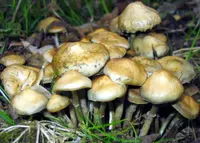
To recognize Psilocybe ovoideocystidiata, look for a smooth, convex to broadly bell-shaped cap about 1-2 inches (2.5-5 cm) across, a slender whitish stem roughly 2-6 inches (5-15 cm) long, and dark purple-brown gills.

A partial veil often leaves a thin ring zone high on the stem, adding a useful first-glance structural clue.

Psilocybe ovoideocystidiata Identification

Check Your Plant ID

Take or upload a photo to confirm your plant ID with Botan.

Clear images work best. Avoid photos taken too close or too far away

Use a few visible features together before drawing a conclusion.

  • Cap is broadly convex to nearly flat, often with a low central bump, about 0.6-2 inches (1.5-5 cm) across.
  • Gills are crowded and attached to the stem, starting pale and becoming dark purplish brown.
  • Stem is slender, usually 1.5-5 inches (4-13 cm) long, pale to yellowish, and often slightly thicker near the base.
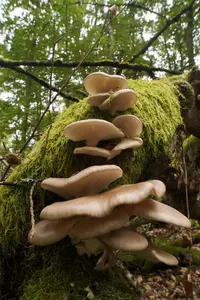
  • Mushrooms often appear in small clusters rather than singly.

Check several traits at once, especially cap shape, darkening gills, and the long slender stem.

Psilocybe ovoideocystidiata shows clear, identification-useful changes as the fruitbody expands and ages.

  • Young plant: Pins begin as compact, dark brown buttons with a rounded cap margin tucked inward and a short, thick stem.
  • Mature plant: Expanded specimens show a broadly convex to nearly flat cap, often 1-4 inches (3-10 cm) wide, with a longer, more evident stem.
  • Fruiting stage: As fruiting bodies age, the cap surface often pales from darker chestnut to tan, while the veil breaks and leaves a fragile ring zone.

Psilocybe ovoideocystidiata is most useful seasonally when fruiting bodies appear in spring. Fresh mushrooms are often seen from mid-spring into early summer, forming clusters on woody debris in floodplain habitats. At that time, look for moist, chestnut- to caramel-brown caps that can fade paler as they dry, along with a ring on the stem and dark purplish-brown gills as spores mature.

Psilocybe ovoideocystidiata is reliably associated with eastern North America, especially the Ohio River Valley and parts of the mid-Atlantic. Reports center on states such as Ohio, Pennsylvania, West Virginia, Kentucky, and nearby areas, which makes geography a useful first filter. It typically fruits on woody debris, mulch, and flood-scoured plant material in riparian settings such as riverbanks, creek edges, and low floodplains. Finding it in spring on wood-rich debris near moving water helps narrow identification better than woodland location alone.


  • Psychoactive ingestion risk: The fruiting bodies contain psilocybin and related compounds. Ingestion can cause strong mental and physical effects in humans. Keep mushrooms away from children and pets.
  • Dangerous mushroom confusion: Misidentification is a serious poisoning risk for humans. Some deadly Galerina species can grow on wood in similar places; Galerina typically has a rusty-brown spore print, while Psilocybe ovoideocystidiata has a dark purplish-brown spore print.

Does Your Plant Match?

Use Botan to compare a photo and help confirm the identification before you spend more time researching.

FAQ

Look for a caramel to chestnut cap that fades paler as it dries, dark purple-brown spore deposit, and blue bruising on the cap or stem. It often fruits on woody debris near floodplains in spring.

More Plant Identification Guides

Identify It. Learn More About It.

Use Botan to identify it from a photo, then get species-specific plant details, care information, and safety notes.

Botan app identifying a plant from a photo
Best Bedroom Plants – Top 10 to Grow in Your Space

8 min read · 8 Jul 2026

Best Bedroom Plants – Top 10 to Grow in Your Space

Discover the top 10 houseplants that are suitable for growing in your bedroom. Compare their light and water needs, pet safety, and benefits. Find out where best to place greenery in your relaxation space and what species to avoid.

Plant Recommendations
Best Bedroom Plants – Top 10 to Grow in Your Space
12 Best Plants That Repel Spiders For Your Home and Garden

8 min read · 24 Jul 2026

12 Best Plants That Repel Spiders For Your Home and Garden

Spiders constantly appear in places you don't want them. A few common plants can help repel them using scent alone. Here are 12 options suitable for both indoors and outdoors, plus care tips for each.

Plant Recommendations
12 Best Plants That Repel Spiders For Your Home and Garden
How to Water Houseplants: Watering Guide

7 min read · 24 Aug 2026

How to Water Houseplants: Watering Guide

Learn how often to water indoor plants, key factors for proper watering, and how to adjust the care routine by plant type, season, pot size, light, and indoor conditions.

Plant Care
How to Water Houseplants: Watering Guide