Planting depth check
Position buds or crowns just at or barely below soil level when planting or dividing, since planting too deep greatly reduces flowering and can lead to crown rot.

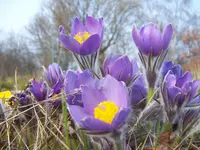
Eastern pasqueflower (Pulsatilla patens) is a small, early-blooming perennial from cold, open grasslands and light woodlands in northern Europe, Asia, and North America. It forms low clumps of finely divided, silky foliage and produces nodding, bell-shaped flowers in soft purple, followed by decorative, feathery seed heads.
This species prefers sunny, well-drained sites and does not tolerate heavy, waterlogged soils. It grows slowly and dislikes root disturbance, which can make it a bit challenging for beginners.
Gardeners who want to learn how to care for eastern pasqueflower benefit from understanding its need for stable conditions and protection from competition by more vigorous plants.

Care Difficulty
Moderate Care

Light Preference
Full Sun

Water Requirements
Low Water

Temperature Preference
Cold Hardy

Hardiness Zone
2–7

Soil Texture
Sandy, Loamy, Rocky

Soil pH
Slightly acidic (6.5–7.0), Neutral (7.0)

Soil Drainage
Well-drained

Fertilization
Minimal (feed rarely)
Scan your plant to receive care tips personalized for your specific plant
Available on iOS and Android
This cold-climate perennial prefers bright, open conditions to form compact, floriferous clumps.
This species prefers slightly dry, free-draining conditions and is sensitive to excess moisture around the roots.
This hardy perennial is adapted to cold climates and tolerates a wide range of outdoor temperatures when planted in the ground.
Humidity is not a major factor for Pulsatilla patens, which thrives in relatively dry air.
Pulsatilla patens prefers lean, well-drained, slightly alkaline soil that mimics open, rocky grasslands.
This species can be grown in containers, but it performs best when conditions closely mimic dry, rocky ground.
This native perennial prefers lean soil, so eastern pasqueflower needs only light, occasional feeding in poor sites.
Pulsatilla patens needs minimal pruning, mainly to keep the clump healthy and tidy.
This species dislikes root disturbance, so transplant Pulsatilla patens only when clearly necessary.
Gardens usually rely on seeds for new Pulsatilla patens plants, as division is stressful for its taprooted system.
This cold-hardy perennial usually needs little special winter care in the ground.

Plant Health Check
Not sure what's wrong with your plant? Check your plant's health inside the app.
This species often flowers while snow is still present, with its buds adapted to low soil temperatures typical of early spring in boreal and continental climates.
The stems, leaves, and outer sepals are densely covered with silky hairs that trap air, helping protect the tissues from frost, rapid temperature swings, and desiccating wind.
Each seed is attached to a long, feathery, spirally twisted style that acts like a wind sail and, once on the ground, can coil and uncoil with humidity changes to help drill the seed into the soil surface.

In parts of its northern range, this early-flowering species is considered a key phenological indicator, meaning its first bloom dates are used by ecologists to track long-term shifts in spring timing and climate change impacts on boreal and steppe ecosystems.
This species usually blooms very early in spring, often as snow melts. Individual flowers typically last 1–2 weeks, but the overall display can extend several weeks as different buds open in sequence.
Keep your plants happy and healthy with plant identification, disease detection, and easy care guidance.