flamevine Care (Pyrostegia venusta)

Also known as: Orange trumpet, Orange trumpet creeper, Brazilian flame creeper, Orange Trumpet Vine, Golden shower
flamevine

About flamevine

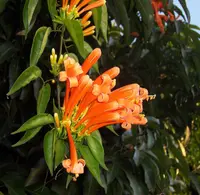
Flamevine, Pyrostegia venusta, is a vigorous evergreen climber known for its dense clusters of bright orange tubular flowers in cooler months. It typically covers fences, walls, or pergolas with a thick curtain of foliage and blooms.

This species is native to South America, especially Brazil, and thrives in warm, frost-free climates. It grows fast and can become heavy, so it needs strong support and occasional pruning.

For those learning how to care for flamevine, its main needs are plenty of sun, moderate moisture, and well-drained soil. Under suitable conditions it is generally considered an easy, reliable ornamental vine.

Main Plant Requirements

Care Difficulty

Moderate Care

Light Preference

Full Sun

Water Requirements

Moderate Water

Temperature Preference

Tropical / Frost Sensitive

Hardiness Zone

9–11

Soil Texture

Sandy, Loamy, Organic-rich

Soil pH

Acidic (5.5–6.5), Slightly acidic (6.5–7.0)

Soil Drainage

Well-drained

Fertilization

Light (every 4–6 weeks)

Get Personalized Care Plan

Scan your plant to receive care tips personalized for your specific plant

Available on iOS and Android

How to Care for the flamevine

Pyrostegia venusta flowers best with abundant direct sun in mild to warm climates.

  • Provide 6–8 hours of direct sun daily; full sun is ideal, especially morning to early afternoon exposure.
  • Tolerates light partial shade (3–4 hours sun), but flowering decreases and vines may stretch with sparse blooms.
  • In very hot regions, give protection from harsh late-afternoon summer sun to reduce leaf scorch and drying winds.

Water needs are moderate and depend on soil drainage and seasonal weather.

  • Allow the top 3–5 cm of soil to dry before watering, then soak deeply so moisture reaches the full root zone.
  • Use well-drained soil; persistent puddling, sour smell, or soft, yellowing lower leaves suggest overwatering and root stress.
  • In hot, dry periods, expect to water more often, while in cool or rainy seasons, extend intervals and rely more on natural rainfall.

This vine prefers warm, frost-free conditions for reliable growth and flowering.

  • Optimal growth occurs around 65–85°F (18–29°C), with steady warmth supporting vigorous vines and abundant blooms.
  • It tolerates brief drops to about 30–32°F (-1–0°C), but repeated frosts can burn foliage and damage young shoots.
  • In hotter areas, it copes with 90–95°F (32–35°C) if soil moisture is maintained and roots are insulated with mulch.

This species tolerates a wide humidity range and does not usually need special humidity management outdoors.

  • Target 40–60% humidity; brief drops lower are usually tolerated without harm to flamevine.
  • Watch for crisp leaf tips and stalled new growth as signs of persistent air that is too dry.
  • In very dry, hot sites, group plants near other vegetation or windbreaks to slightly reduce moisture loss.

This vigorous climber prefers well-structured, free-draining soil that still holds moderate moisture.

  • Use a loamy or sandy-loam soil enriched with 20–30% compost to support rapid growth without waterlogging.
  • Aim for slightly acidic to neutral pH, around 6.0–7.0, which suits Pyrostegia venusta root function and nutrient uptake.
  • Improve drainage and aeration by blending in coarse sand or fine bark plus 10–20% perlite, especially in heavier soils.
  • Avoid compacted clay, standing water, or mixes dominated by fine peat that stay wet and exclude air around the roots.

This species can be grown successfully in containers when given enough root volume and structural support.

  • Choose a large, heavy container to counterbalance the vine’s top weight and reduce tipping in strong wind.
  • Provide a tall, firmly anchored trellis or wires fixed directly to the pot to guide and support climbing shoots.
  • Use a deep, free-draining potting mix and raise the container slightly on feet so drainage holes never sit in collected water.

Pyrostegia venusta responds well to moderate feeding during its active growing season.

  • Use a balanced, slow-release fertilizer (for example 10-10-10) or well-rotted compost in spring to support vigorous vine and flower growth.
  • Feed every 6–8 weeks during warm, active growth, adjusting for soil richness and plant vigor.
  • Apply granular products at the recommended label rate or liquid feeds at 1/2 strength to avoid salt buildup and root burn.
  • Reduce or stop feeding in late fall and winter when growth slows, especially in cooler climates.

Pruning helps manage the vigorous growth and flowering performance of Pyrostegia venusta.

  • Carry out main pruning in late winter or very early spring, after the main flowering flush has finished.
  • Remove dead, damaged, or diseased stems first, then thin congested growth to improve light and air penetration.
  • Shorten overly long or wandering shoots to keep the vine within its support and maintain a tidy outline.
  • Use sharp, clean bypass pruners and make cuts just above a leaf node to encourage healthy new shoots.

Flamevine is usually grown in the ground, but container plants or young vines benefit from thoughtful transplanting.

  • Transplant or shift to a larger container in spring when growth restarts and roots are circling the pot or top growth stalls.
  • Plan on moving young container plants every 1–2 years until they reach a stable size and strong support structure.
  • Choose a slightly larger pot or planting hole with free-draining soil and a sturdy trellis or fence already in place.
  • Water thoroughly before and after moving, keep roots shaded, and avoid disturbing the root ball more than necessary to reduce stress.

Pyrostegia venusta is commonly propagated from semi-ripe cuttings or layering for reliable results.

  • Take semi-ripe stem cuttings in late spring to summer, 8–12 cm long, with at least 2–3 leaf nodes.
  • Dip cut ends in rooting hormone, then insert into a free-draining mix kept at 70–75°F with high humidity and bright, indirect light.
  • Use simple layering by pegging flexible stems onto moist soil until roots form, then sever from the parent vine.
  • Seeds can be sown in warm, sterile mix, though flowering plants from seed take longer to reach maturity.

Pyrostegia venusta is frost-sensitive and benefits from extra attention in cooler climates.

  • In USDA zones 9–11 it usually overwinter outdoors, but growth may slow in the coolest months.
  • In colder areas, grow in containers and move plants indoors or into a greenhouse before temperatures drop near 32°F.
  • Apply 5–8 cm of organic mulch around the root zone in fall to moderate soil temperature and conserve moisture.
  • In marginal climates, wrap exposed stems on supports with frost cloth or burlap during cold snaps to limit tissue damage.

Care Tips

Early support training

Install a sturdy trellis, fence, or wires before planting and loosely tie young stems with soft ties, guiding new shoots horizontally at first to encourage dense coverage instead of one long, bare leader.

Controlled spread management

Inspect boundaries each month in the growing season and promptly cut or dig out any stems that have rooted where they touch the ground, especially near gutters, roofs, or neighboring plants, to prevent invasive spread.

Flowering boost by timing

In frost-free areas, schedule any major pruning for just after the main flowering flush so the plant has a full season to produce new wood, which will carry next season’s flower buds.

Cold protection strategy

In marginal climates, mulch the root zone with a 5–8 cm layer of coarse organic material and protect the lower stems with frost cloth on cold nights to help the plant resprout strongly after light freezes.

Routine pest scouting

Check the undersides of leaves and young shoots every 1–2 weeks for scale insects, aphids, or caterpillars, and treat early with a targeted method such as horticultural oil or hand removal to keep pests from colonizing the extensive vine canopy when growing flamevine.

Common Pests and Diseases

Scale insects

This pest attaches to young stems and the underside of leaves, sucking sap and causing yellowing, leaf drop, and weakened flowering. Symptoms include small, rounded or oval bumps that do not move when touched.

Solution

Prune and dispose of heavily infested stems, then wipe or gently scrub remaining colonies with a cotton pad dipped in diluted rubbing alcohol or insecticidal soap. Improve air movement through the vine canopy and repeat treatments every 7–10 days until new growth appears clean.

Aphids

These insects cluster on tender shoot tips, new leaves, and flower buds, feeding on sap and distorting growth. Symptoms include sticky honeydew on leaves and nearby surfaces, often followed by sooty mold on the sugary residue.

Solution

Spray affected shoots with a firm stream of water to dislodge colonies, then treat remaining insects with insecticidal soap or a dilute neem oil spray, making sure to coat undersides of leaves. Encourage or preserve natural predators such as lady beetles outdoors and monitor new flushes of growth frequently during warm seasons.

Leaf spot

This disease causes small brown, tan, or purplish spots that may expand and merge, leading to premature leaf yellowing and drop, especially on dense, shaded parts of the vine. Symptoms include more severe spotting after periods of warm, wet weather or overhead irrigation.

Solution

Remove and discard affected leaves and any fallen debris around the base to reduce fungal spores, then water at soil level to keep foliage dry. Improve light penetration and airflow by thinning crowded stems, and use a labeled copper or chlorothalonil fungicide only if spotting continues to spread on new growth.

Powdery mildew

This disease produces white, powdery patches on upper leaf surfaces and sometimes on young stems, which can lead to leaf distortion and reduced flowering. Symptoms include increased severity in warm days, cool nights, and where air circulation is poor around the vine canopy.

Solution

Cut back and discard the most affected shoots, then space and train stems so air can move freely through the plant. Avoid overhead watering, and apply a sulfur-based or potassium bicarbonate fungicide according to label directions if new leaves keep developing the white coating.

Interesting Facts

Winter flowering strategy

In many subtropical regions, this species flowers most heavily in late winter when few other plants are in bloom, giving it a strong advantage in attracting pollinators during a low-competition period.

Specialized flower structure

Its long tubular orange flowers are adapted for pollination by hummingbirds and certain long-tongued insects, which can reach nectar deep inside while transferring pollen between blossoms.

Climbing with tendrils

This vine climbs using branched tendrils that arise from its inflorescences, allowing it to anchor onto rough surfaces such as tree bark, fences, or masonry without twining around supports.

Botan icon

Did you know?

In some regions outside its native range in South America, this species has naturalized along roadsides, railways, and disturbed sites, forming dense flowering curtains that can significantly alter the appearance and light conditions of local vegetation edges.

FAQs about flamevine

Lack of flowers usually comes from insufficient light, heavy nitrogen fertiliser, or pruning at the wrong time that removes flowering wood. Mild, dry winters and a short rest period often trigger better blooming in this species.

Grow Healthy Plants with Botan Care

Keep your plants happy and healthy with plant identification, disease detection, and easy care guidance.

Botan plant care app — identify plants on mobile

Explore More Plants