Rootstock selection
Use a drought-tolerant, compatible pear or quince rootstock suited to your soil type, as rootstock choice will strongly influence vigor, final size, and resilience in dry, rocky sites when growing Syrian Pear.

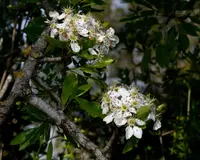
Syrian pear, Pyrus syriaca, is a hardy deciduous tree valued mainly as a rootstock and for windbreaks rather than for dessert-quality fruit. It typically develops an open, rounded crown with small leaves and produces modest, firm pears that are often used cooked or for livestock.
This species is native to the Eastern Mediterranean and parts of Western Asia, where it copes with hot, dry summers and poor, stony soils. Its strong drought and cold tolerance make it useful in challenging sites, though it prefers full sun and well-drained ground.
Gardeners who want to care for Syrian Pear usually find it undemanding once established, provided it is not kept in waterlogged or heavily shaded conditions.

Care Difficulty
Moderate Care

Light Preference
Full Sun

Water Requirements
Moderate Water

Temperature Preference
Cold Hardy

Hardiness Zone
5–8

Soil Texture
Sandy, Loamy, Clay

Soil pH
Slightly acidic (6.5–7.0), Slightly alkaline (7.0–7.5)

Soil Drainage
Well-drained

Fertilization
Minimal (feed rarely)
Scan your plant to receive care tips personalized for your specific plant
Available on iOS and Android
This species thrives in open, bright sites with strong, direct sun.
This tree prefers deep, infrequent watering that allows soil to dry slightly between soakings.
This hardy species is adapted to continental climates with cold winters and warm summers.
This species tolerates a wide humidity range and rarely needs special humidity management outdoors.
Pyrus syriaca prefers moderately fertile, well-structured mineral soil that drains freely yet holds some moisture.
This species can be grown in large outdoor containers, but only when the pot is sized and weighted for a long-lived tree.
Wild-type Pyrus syriaca usually grows on poor soils with minimal feeding, but light nutrition improves performance in gardens and orchards.
Pruning Pyrus syriaca keeps the crown stable, safe, and well-lit while maintaining natural form.
This species is typically field-grown, so focus on careful transplanting rather than frequent repotting.
Pyrus syriaca is usually propagated professionally, but home growers can raise plants from seed or grafting material.
Mature Pyrus syriaca is cold hardy in most temperate climates and generally needs minimal winter care.

Plant Health Check
Not sure what's wrong with your plant? Check your plant's health inside the app.
Pyrus syriaca is widely used as a hardy rootstock for grafting cultivated pear varieties in parts of the Middle East because it tolerates poor, dry, and stony soils better than many commercial pear species.
This species is naturally distributed in dry woodlands, rocky slopes, and steppe margins of Syria, Lebanon, Turkey, and neighboring regions, where it forms scattered trees and thickets that stabilize fragile soils.
The fruits are typically small, hard, and strongly astringent when fresh, yet they are locally collected and sometimes used in traditional preserves or dried, reflecting long adaptation to use in resource-limited, semi-arid landscapes.

Genetic studies indicate that Pyrus syriaca has contributed to the diversity of cultivated pears in Western Asia, acting as one of several wild gene sources that introduced drought tolerance and disease resistance traits into local landraces.
This species grows at a moderate rate, usually adding 20–40 cm of height per year in good conditions. It often needs 10–15 years to approach mature size and reliable fruiting.
Keep your plants happy and healthy with plant identification, disease detection, and easy care guidance.