


sawtooth oak Identification (Quercus acutissima)

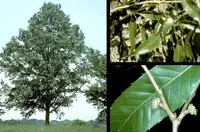
Recognize sawtooth oak by its long, narrow leaves with sharp, bristle-tipped teeth along the margins, arranged alternately on the twigs. The crown is broad and rounded, and the bark becomes dark gray and deeply furrowed on mature trunks.

Another strong clue is the very large acorn cup, which encloses much of the nut.

Quercus acutissima Identification

Is This sawtooth oak?

Take a photo and use Botan to confirm your plant identification.

Clear images work best. Avoid photos taken too close or too far away

  • 1 free identification
  • No sign-up
  • 30,000+ plants in database

Check the leaves, twigs, and acorns for a fast visual ID.

  • Leaves are long and narrow, about 4 to 8 inches (10 to 20 cm), with many sharp, bristle-tipped teeth along each edge.
  • Leaf veins run straight from the midrib to each tooth, giving the blade a regular, ladder-like pattern.
  • Twigs often carry slender, pointed buds clustered near the tips.
  • Acorns are short and broad, with a deep cup covered in long, narrow scales that look shaggy.

A shaggy acorn cup plus sharply toothed leaves is especially useful for confirming Quercus acutissima.

Sawtooth oak shows useful visual differences from sapling form to fruiting branches.

  • Seedling: Seedlings carry simple alternate leaves early, with narrow blades and already distinct bristle-tipped teeth; the stem is slender and upright, with little branching.
  • Young plant: Young plants form a narrow, strongly upright crown. Leaves become longer, often 4-8 inches (10-20 cm), with deeper, more regular saw-edged margins than seedlings.
  • Mature plant: Mature trees develop a broad rounded crown and thick furrowed bark. Lower limbs spread outward, and the trunk becomes visually dominant instead of the central leader.
  • Fruiting stage: Fruiting branches show many ovoid acorns borne near shoot tips, each set in a cup with long, bristly scales that stands out clearly.

In spring, sawtooth oak leafs out with fresh green, sharply toothed leaves, and its flowers appear at the same time. Drooping yellowish male catkins are the easiest spring clue. By late summer into fall, acorns become obvious, each set in a bristly cup. Fall color is often yellow to yellow-brown before leaf drop, after which the rough gray-brown bark and stout twigs are easier to see.

Several Asian oaks can be mistaken for sawtooth oak.

oriental cork oak(Quercus variabilis)

Often confused because both have long, chestnut-like serrated leaves. Oriental cork oak usually shows gray bark with thick, corky ridges, while Quercus acutissima has less corky bark and acorn cups with longer, more bristle-like scales.

Japanese emperor oak(Quercus dentata)

Can overlap in leaf size and coarse teeth. Japanese emperor oak has much broader leaves, often 8 to 16 inches (20 to 40 cm) long, with fewer, larger teeth and a pale, fuzzy underside; sawtooth oak leaves are narrower and more evenly serrated.

Quercus acutissima is native to East Asia, including China, Korea, Japan, and parts of the Himalayas. It occurs in broadleaf and mixed forests, often on hillsides, valley margins, and lower mountain slopes. This range helps with identification because a similar oak found growing wild far outside East Asia is less likely to be this species. In its native habitat, it is typically part of open woodland or forest edges rather than wetlands or coastal dunes.

  • Acorns and foliage: Acorns, young leaves, and buds contain tannins. Ingestion can harm pets and livestock, especially dogs, horses, and cattle. Large amounts are the main concern.
  • Spiny acorn cups: The acorn cup has long, stiff bristles. Skin contact can cause minor punctures or irritation in people handling fallen acorns or branches.

Does Your Plant Match?

Use Botan to compare a photo and help identify it or confirm the name before you label or buy.

FAQ

The long, chestnut-like leaves are the clearest clue. They are usually 4 to 8 inches (10 to 20 cm) long with many sharp, bristle-tipped teeth, giving this species its distinctive saw-edged outline.

More Plant Identification Guides

Know What Plant You Have

Identify it from a photo with Botan, then get plant details, care information, and common problems for that species.

Botan app identifying a plant from a photo
12 Most Wanted Rare Houseplants to Grow at Home

6 min read · 21 Sept 2026

12 Most Wanted Rare Houseplants to Grow at Home

Rare houseplants can turn an ordinary corner in your apartment into a living botanical collection. This guide covers 12 most admired picks, what makes them special, and how to grow them successfully at home.

Plant Recommendations
12 Most Wanted Rare Houseplants to Grow at Home
How To Revive a Dying Plant: 6 Steps To Bring A Plant Back To Life

6 min read · 1 Sept 2026

How To Revive a Dying Plant: 6 Steps To Bring A Plant Back To Life

Drooping leaves and brown tips don't always mean the end, and a weakened plant can often recover with a little help. These six simple steps will help you revive a dying plant and restore its health.

Plant Care
How To Revive a Dying Plant: 6 Steps To Bring A Plant Back To Life
8 Glow-in-the-Dark Plants and Fungi That Really Exist

8 min read · 6 Nov 2026

8 Glow-in-the-Dark Plants and Fungi That Really Exist

Plants that glow in the dusk really exist. Some of them produce their own light, while others need UV exposure or special treatments. Explore eight fascinating examples, including glowing petunias, bioluminescent mushrooms, fluorescent flowers, and experimental succulents.

Plant Recommendations
8 Glow-in-the-Dark Plants and Fungi That Really Exist