Root flare check
When planting or inspecting an established tree, locate the root flare at the base of the trunk and keep it slightly above surrounding soil or mulch to prevent rot and girdling roots over time.

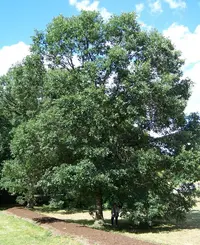
Swamp white oak, Quercus bicolor, is a hardy deciduous tree native to lowland forests and wet areas of eastern and central North America. It is grown mainly as a landscape and shade tree.
Mature trees develop a broad, rounded crown, rough gray bark, and glossy green leaves that turn yellow to bronze in fall. Acorns provide food for wildlife and support local ecosystems.
This species tolerates periodic flooding and heavy soils better than many other oaks, which makes it adaptable in urban and park settings. Understanding how to care for swamp white oak starts with providing full sun, consistent moisture, and moderately fertile, well-drained soil.

Care Difficulty
Moderate Care

Light Preference
Full Sun

Water Requirements
Regular Water

Temperature Preference
Cold Hardy

Hardiness Zone
4–8

Soil Texture
Loamy, Clay, Organic-rich

Soil pH
Acidic (5.5–6.5), Slightly acidic (6.5–7.0)

Soil Drainage
Moist but well-drained

Fertilization
Minimal (feed rarely)
Scan your plant to receive care tips personalized for your specific plant
Available on iOS and Android
This oak thrives in full sun but tolerates some light shade, especially when young.
This species prefers consistently moist, deep soils but adapts once established.
This hardy oak is adapted to cold winters and warm summers in temperate climates.
Humidity is not a major factor for Quercus bicolor, which is adapted to outdoor conditions in temperate climates.
Quercus bicolor prefers deep, moist, well-aerated soil that holds water yet does not stay saturated.
This species is only suitable for short- to medium-term container growing, mainly for young trees or temporary placement.
Mature Quercus bicolor in the ground usually needs little fertilizer if soil is reasonably fertile.
Pruning Quercus bicolor focuses on structural strength and removal of problem wood rather than frequent shaping.
Swamp white oak is rarely kept long term in containers, so management centers on careful field transplanting of young trees.
Propagation of Quercus bicolor is usually done from seed rather than vegetative methods at home scale.
Established swamp white oak is very cold hardy and usually needs minimal winter care in the landscape.

Plant Health Check
Not sure what's wrong with your plant? Check your plant's health inside the app.
Swamp white oak naturally hybridizes with several other white oaks, especially bur oak (Quercus macrocarpa), forming stable hybrid swarms in the wild that help scientists study gene flow and adaptation in oak forests.
This species is native to poorly drained, seasonally flooded soils in the Midwestern and Northeastern US and has roots and trunk tissues that tolerate low-oxygen conditions that would stress many other hardwood trees.
Its leaves show a distinct bicolor pattern, with a dark green upper surface and a much paler, almost silvery underside, a feature that inspired its species name bicolor and helps distinguish it from related oak species.

Long-lived individuals of swamp white oak in natural stands are documented at 300–350 years old, making this species one of the more enduring canopy trees in eastern North American floodplain forests.
This tree usually grows at a moderate rate of about 30–60 cm per year once established. Growth is faster in deep, moist, well-drained soil and full exposure, and slower in compacted or very dry sites.
Keep your plants happy and healthy with plant identification, disease detection, and easy care guidance.