
swamp white oak Identification (Quercus bicolor)

Recognize swamp white oak by its oblong leaves, usually 4 to 7 inches (10 to 18 cm) long, with shallow rounded lobes and a distinctly pale, whitish underside.

Also check the twigs and bark: twigs are stout, and mature trunks develop light gray bark that peels in thin, irregular flakes.

Quercus bicolor Identification

Is This swamp white oak?

Check your plant ID by uploading a clear photo to Botan.

Clear images work best. Avoid photos taken too close or too far away

  • 1 free identification
  • No sign-up
  • 30,000+ plants in database

Check a few clear leaf, bark, and acorn traits on Quercus bicolor.

  • Leaves are simple, alternate, and 4-7 inches (10-18 cm) long, widest above the middle.
  • Leaf edges have shallow, rounded lobes or coarse teeth, not deep cuts.
  • The leaf underside looks pale whitish and often slightly fuzzy, contrasting with the darker top.
  • Bark is gray-brown and breaks into loose, irregular plates that can peel slightly.
  • Acorns are 3/4-1 inch (2-2.5 cm) long, with a cup that covers about one-third to one-half of the nut.

Use several traits together, especially leaf shape, pale undersides, and acorn form.

Swamp white oak shows clear visual shifts from sapling form to acorn-bearing canopy tree.

  • Seedling: Seedlings carry alternate, simple leaves that are already broadest above the middle, with pale undersides and a slender green stem rising from the acorn.
  • Young plant: Young plants form an upright small tree, often 6-15 feet (1.8-4.6 m) tall, with ascending branches and leaves showing shallow rounded lobes or coarse teeth.
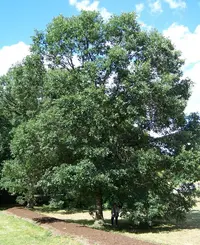
  • Mature plant: Mature trees develop a broad, rounded crown, heavier horizontal limbs, and gray-brown bark that breaks into loose plates, unlike the smoother stems of younger plants.
  • Fruiting stage: Fruiting branches show short-stalked acorns, usually 3/4-1 inch (2-2.5 cm) long, with a shaggy cup covering about one-third to one-half of the nut.

In spring, Quercus bicolor leafs out with pale, downy new leaves that soon show the species’ two-toned look: dark green above and whitish below. Flowering catkins also become visible in spring, hanging as the leaves expand. By fall, acorns are noticeable and the foliage turns yellow-brown to brown before dropping. After leaf fall, the broad, open crown and scaly gray bark are easier to see.

A few white oaks are easy to confuse at a glance.

bur oak(Quercus macrocarpa)

Both have broad, rounded-lobed leaves with pale undersides. Bur oak usually has a deep middle “waist,” making a fiddle shape; swamp white oak leaves are more evenly oval with shallow lobes. Its acorn cups are also much deeper and fringed.

overcup oak(Quercus lyrata)

Both favor wet sites and can show whitish leaf undersides. Overcup oak leaves are more distinctly lyre-shaped, with deeper lower sinuses and a squarer upper half. Its acorns are mostly enclosed by the cup, unlike the shallower cups here.

Quercus bicolor is native to eastern and central North America, from southern Canada south through the northeastern and midwestern United States and into parts of the Appalachian region. It is most often found in bottomland woods, floodplain forests, stream edges, and other seasonally wet lowlands. That setting is a useful clue because this oak is more likely in wetlands and poorly drained ground than many similar upland white oaks.

  • Acorns and young leaves: Quercus bicolor contains tannins, especially in acorns and young leaves. Ingestion can be harmful to humans and pets, and livestock are also known to be affected.
  • Handling: No well-established skin hazard is associated with normal contact with Quercus bicolor. The main concern is ingestion rather than touching bark, leaves, or acorns.

Check Your Plant ID

Use Botan to compare a photo and help identify or verify the plant before you label it or make planting decisions.

FAQ

The clearest field mark is the two-toned leaf: dark green above and distinctly whitish, almost silvery below. Rounded lobes or coarse teeth and a long-stalked leaf shape also support swamp white oak identification.

More Plant Identification Guides

Identify Your Plant with Botan

Upload a photo to identify it, then review plant details, care information, and common problems matched to the result.

Botan app identifying a plant from a photo
Plant Pot Sizes: How to Choose the Right Plant Container

7 min read · 20 Aug 2026

Plant Pot Sizes: How to Choose the Right Plant Container

Plant pot sizes can be confusing because the number on the label only tells you part of the required information. A container may look spacious but actually be too shallow. So, how to choose pot size for plant species?

Beginner Guides
Plant Pot Sizes: How to Choose the Right Plant Container
Dill Companion Plants – What to Grow Next to Dill

9 min read · 17 Jul 2026

Dill Companion Plants – What to Grow Next to Dill

Dill is an easy-to-grow plant that gets along well with many vegetables. This guide describes 15 plants that can be planted alongside it, a few to avoid, and mistakes that can quietly sabotage the entire process.

Plant Recommendations
Dill Companion Plants – What to Grow Next to Dill
Best Time to Water Grass in Summer – Lawn Watering Tips

5 min read · 21 Jul 2026

Best Time to Water Grass in Summer – Lawn Watering Tips

Summer watering is easy to get wrong. This guide explains when to turn on your sprinkler, how much liquid your grass needs each week, and how to tell if you're overwatering or underwatering.

Plant Care
Best Time to Water Grass in Summer – Lawn Watering Tips