


Scarlet Oak Identification (Quercus coccinea)

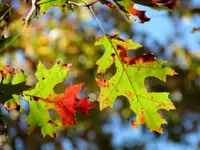
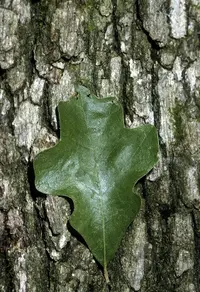
Recognize Scarlet Oak by its alternate leaves with 7-9 deep, sharply cut lobes ending in bristle tips, often with broad U-shaped sinuses nearly reaching the midrib.

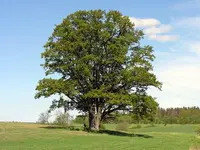
It usually forms a straight trunk and an open, rounded crown, with small acorns about 1/2 inch (1.3 cm) wide in shallow, saucer-like caps.

Quercus coccinea Identification

Identify Your Plant with Botan

Upload a clear photo to check your plant identification with Botan.

Clear images work best. Avoid photos taken too close or too far away

  • 1 free identification
  • No sign-up
  • 30,000+ plants in database

Check the leaves, twigs, bark, and acorns for a quick visual read.

  • Leaves are simple and alternate, usually 3-6 inches (8-15 cm) long.
  • Each leaf often has 7-9 deep lobes with narrow, bristle-tipped points and broad, open sinuses.
  • Lobes look sharply cut, giving the leaf a more angular outline than a rounded one.
  • Bark on the trunk is dark gray to nearly black with long ridges and shallow furrows.
  • Acorns are oval, about 1/2-1 inch (1.3-2.5 cm) long, with a shallow, bowl-like cap covering about one-third.

Use several traits together, since bark or acorns alone may not be enough.

Quercus coccinea shows clear visual shifts from seedling leaves to broad-crowned, acorn-bearing maturity.

  • Seedling: Seedlings have alternate, simple leaves with already deep, bristle-tipped lobes, but on a thin upright stem with few side branches.
  • Young plant: Young plants form a narrow, straight trunk and ascending branches; leaves enlarge to about 3-6 inches (8-15 cm) long and look more evenly cut.
  • Mature plant: Mature trees develop a tall trunk and a broader, more open crown, with heavier limbs and a stronger contrast between upper branches and lower trunk.
  • Fruiting stage: Fruiting branches carry rounded acorns set singly or in pairs, each partly enclosed by a shallow cap, adding a visible structure absent on nonfruiting plants.

In spring, new leaves emerge bright green with bristle-tipped lobes, while small yellow-green catkins may hang below the twigs. Acorns become noticeable by late summer into fall, sitting in shallow, saucer-like caps. The clearest clue comes in fall, when Scarlet Oak turns vivid scarlet to red before leaf drop. After leaves fall, the broad crown and dark, ridged bark are easier to see.

Several red oaks can be mistaken for Quercus coccinea.

Northern red oak(Quercus rubra)

Both have pointed, bristle-tipped lobes. Northern red oak usually has shallower sinuses, often less than halfway to the midrib, while scarlet oak has deeper cuts. Bark on mature northern red oak shows broad, pale ski-track ridges.

Pin oak(Quercus palustris)

Both have deeply lobed leaves with bristle tips. Pin oak usually has lower branches that angle downward and small, round acorns with a shallow cap. Scarlet oak more often has a broader crown and acorn cups that cover about one-third to one-half of the nut.

Quercus coccinea is native to eastern and central North America, from southern Maine and Ontario south to Georgia and Alabama, and west to Missouri and Mississippi. It is most often found in dry to moderately moist upland oak forests, ridges, and sandy or rocky slopes, rather than swamps or bottomlands. In the field, that setting helps separate it from some other red oaks that are more typical of wetter lowland woods.

Quercus coccinea has a meaningful safety concern because its acorns and leaves contain tannins. Risk is mainly from ingestion, especially for pets and livestock, and less often for people.

  • Acorns and leaves: Ingestion of acorns or fallen/wilted leaves can be harmful. Tannins are the main concern, especially for dogs, cats, horses, and livestock.

Confirm the Species with Botan

Upload a photo to compare key features and get help identifying the plant or checking if your current ID is correct.

FAQ

Leaves are usually 3 to 7 inches long (8 to 18 cm), with 7 to 9 sharply pointed lobes and deep sinuses, or cut-in spaces, often extending close to the midrib.

More Plant Identification Guides

Scan Your Plant. Get the Details.

Identify a plant from a photo with Botan, then see its profile, care information, and common problems.

Botan app identifying a plant from a photo
What Do Plants Need to Grow – 5 Things Every Greenery Can't Live Without

8 min read · 31 Jul 2026

What Do Plants Need to Grow – 5 Things Every Greenery Can't Live Without

To keep plants healthy and thriving, provide the right balance of light, humidity, nutrients, airflow, and quality soil. This guide covers the essentials of year-round plant care.

Beginner Guides

What Do Plants Need to Grow – 5 Things Every Greenery Can't Live Without
12 Best Landscaping Trees for Your Garden

8 min read · 6 Oct 2026

12 Best Landscaping Trees for Your Garden

Choosing the landscape tree depends on what your garden needs most. These 12 options include compact flowering specimens, colorful deciduous trees, shade varieties, and evergreens suitable for screening and year-round structure.

Plant Recommendations
12 Best Landscaping Trees for Your Garden
When to Harvest Tomatillos: How to Tell When They're Ripe

4 min read · 20 Oct 2026

When to Harvest Tomatillos: How to Tell When They're Ripe

Tomatillos grow inside papery husks, making it hard to judge ripeness at a glance. This guide explains how to know when tomatillos are ripe and offers practical advice on harvesting and storage.

Plant Recommendations
When to Harvest Tomatillos: How to Tell When They're Ripe