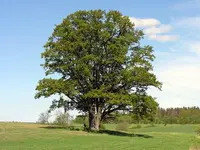



English oak Identification (Quercus robur)

Recognize English oak by its rounded, deeply lobed leaves set alternately on twigs, usually with very short leaf stalks. The leaves often show small ear-like lobes at the base where they meet the stalk.

Also check for acorns borne on long stalks and a broad, sturdy trunk with thick, ridged bark.

Quercus robur Identification

Check Your Plant ID

Check your plant ID by uploading a clear photo to Botan.

Clear images work best. Avoid photos taken too close or too far away

  • 1 free identification
  • No sign-up
  • 30,000+ plants in database

Use these visible traits to check for Quercus robur.

  • Leaves are simple and alternate, usually 4-6 inches (10-15 cm) long, with 4-7 rounded lobes on each side.
  • The leaf base has small ear-like lobes that clasp the short leaf stalk.
  • Acorns sit in shallow scaly cups and are carried on long stalks, often in small groups.
  • Twigs look stout, with clustered buds packed near the tips.
  • The trunk often develops thick, deeply fissured gray-brown bark and broad, heavy lateral limbs.

Check several leaves and any acorns together, since the leaf base and long acorn stalks are especially useful.

Quercus robur shows clear visual shifts from lobed seedling leaves to acorn-bearing crowns.

  • Seedling: Seedlings carry simple alternate leaves with rounded lobes on a thin upright stem, often retaining the large acorn at the base early on.
  • Young plant: Young plants form a straight leader with side branches; leaves become broader and more distinctly lobed, often reaching 4-6 inches (10-15 cm) long.
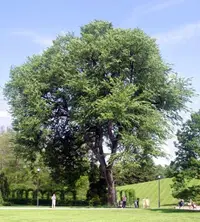
  • Mature plant: Mature trees develop a thick furrowed trunk and a broad, heavy crown with stout limbs, replacing the narrow upright outline of younger plants.
  • Fruiting stage: Fruiting branches show oval acorns borne on long stalks, a clear visual feature absent earlier and especially noticeable against the dense lobed foliage.

English oak has several named forms that are easy to separate by crown shape or leaf pattern.

  • Quercus robur 'Fastigiata': Branches rise steeply to form a narrow, columnar crown, often much tighter than the broad, rounded canopy of the typical tree.
  • Quercus robur 'Pendula': Main branches and side shoots hang downward, creating a distinctly weeping outline instead of an upright spreading crown.
  • Quercus robur 'Concordia': Leaves emerge and stay bright golden yellow through much of the growing season, unlike the usual medium green foliage.
  • Quercus robur 'Filicifolia': Leaves are deeply cut into many narrow lobes, giving a fine, fern-like look rather than the broad lobes of the species.

In spring, Quercus robur leafs out with fresh green, rounded-lobed leaves, and hanging yellow-green catkins can be visible during flowering. By late summer into fall, acorns become noticeable, sitting in shallow cups on stalks. After leaf drop in fall and winter, the broad, sturdy branching pattern is easier to see. Twigs show clustered terminal buds near the tips, which can help with identification when the crown is bare.

Several oaks can be mistaken for Quercus robur.

sessile oak(Quercus petraea)

Similar rounded-lobed leaves and overall crown shape cause confusion. Check the acorns: sessile oak acorns sit almost stalkless, while English oak acorns hang on longer stalks. Its leaf base is usually more tapered, not ear-lobed.

pedunculate oak hybrid(Quercus × rosacea)

This hybrid between Q. robur and Q. petraea often shows mixed traits, so it can resemble either parent. Look for intermediate features: acorn stalks and leaf stalks are both moderate rather than clearly long or very short.

Quercus robur is native across most of Europe and extends into western Asia, from the British Isles through central and eastern Europe to the Caucasus. That range helps separate it from several similar white oaks that are native to North America. In the wild it is most typical of lowland deciduous woodland, parkland remnants, hedgerows, and river valleys, often on deeper, moisture-retentive soils. Finding a large oak in these temperate lowland settings supports identification, especially in long-settled landscapes across Europe.

  • Acorns and leaves: Acorns and young leaves contain tannins. Ingestion can be harmful to humans and pets, especially if eaten in quantity.
  • Pets and livestock: Oak poisoning is best documented in grazing animals and can also affect dogs if acorns or leaves are eaten. The concern is ingestion, not normal skin contact.

Scan. Check. Confirm.

Use Botan to identify or verify a plant from a photo when you want a quick second opinion before labeling it.

FAQ

The clearest feature is the leaf: rounded lobes with very short stalks and small ear-like lobes at the leaf base. Long-stalked acorns also help with English oak identification.

More Plant Identification Guides

Identify Your Plant with Botan

Identify a plant from a photo, then get species-specific care information, safety notes, and common problems.

Botan app identifying a plant from a photo
Best Water for Plants – How to Choose the Right Type

7 min read · 13 Aug 2026

Best Water for Plants – How to Choose the Right Type

Rainwater, filtered, distilled, and tap water affect plants differently. Learn which types support healthy growth and which cause slow damage. Match each to your plants and discover how to easily improve tap water quality.

Plant Care

Best Water for Plants – How to Choose the Right Type
When to Plant Hydrangeas: Best Time by Season and Type

6 min read · 30 Oct 2026

When to Plant Hydrangeas: Best Time by Season and Type

Hydrangeas grow best when you plant them in cool weather. This guide explains when to plant hydrangeas in your area, compares fall and spring planting seasons, and shows the right steps for each type.

Beginner Guides
When to Plant Hydrangeas: Best Time by Season and Type
12 Best Plants That Repel Spiders For Your Home and Garden

8 min read · 24 Jul 2026

12 Best Plants That Repel Spiders For Your Home and Garden

Spiders constantly appear in places you don't want them. A few common plants can help repel them using scent alone. Here are 12 options suitable for both indoors and outdoors, plus care tips for each.

Plant Recommendations
12 Best Plants That Repel Spiders For Your Home and Garden