Host tree selection
Establish the fungus in shaded beds under mature beech or oak where leaf litter stays undisturbed, since compatible tree partners and stable organic debris are critical for long-term colony formation.

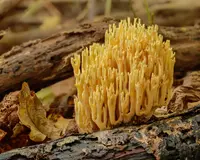
Yellow-tipped coral fungus, Ramaria formosa, is a coral-like forest fungus rather than a true plant. It forms dense, branching clusters that resemble underwater coral, with pinkish to orange bases and yellowish tips. The structure is brittle and often grows from soil rich in decaying wood.
This species occurs mainly in temperate woodlands, especially under beech and other broadleaf trees in North America, Europe, and parts of Asia. It can be difficult to cultivate because it depends on complex relationships with trees and soil fungi. Those looking up how to care for yellow-tipped coral fungus usually focus on maintaining suitable woodland-like conditions with moist, humus-rich soil and shade outdoors, rather than growing it indoors.

Care Difficulty
Hard Care

Light Preference
Shade

Water Requirements
Keep Soil Moist

Temperature Preference
Cool Climate

Hardiness Zone
Unknown

Soil Texture
Loamy, Silty, Organic-rich

Soil pH
Strongly acidic (4.5–5.5), Acidic (5.5–6.5)

Soil Drainage
Moist but well-drained

Fertilization
Minimal (feed rarely)
Scan your plant to receive care tips personalized for your specific plant
Available on iOS and Android
Ramaria formosa prefers low, forest-like light similar to its natural woodland habitat.
Ramaria formosa needs consistently moist, not saturated, forest-floor conditions.
This species prefers cool to mild woodland temperatures and declines in strong heat or hard frost.
This fungus requires consistently moist air and substrate to fruit well.
This species fruits best in loose, humus-rich forest-type substrate rather than standard potting soil.
This fungus is challenging and generally unsuitable for container growing, as it depends on complex woodland and mycorrhizal conditions.
Ramaria formosa is a forest-dwelling fungus that relies mainly on its partnership with tree roots, so additional fertilization is usually unnecessary.
Ramaria formosa is not pruned in the horticultural sense, since its visible coral-like structures are temporary fruiting bodies.
This mycorrhizal fungus is not suited to typical home repotting, since it lives in symbiosis with tree roots in undisturbed soil.
Practical home propagation of Ramaria formosa is difficult and rarely attempted outside specialized research or fungal cultivation projects.
This woodland fungus is naturally cold hardy in temperate climates and does not require targeted winter care in gardens or forests.

Plant Health Check
Not sure what's wrong with your plant? Check your plant's health inside the app.
The fruiting body typically shows pink to salmon branches with yellow tips when young, but often discolors to brownish or grayish with age or handling, which helps distinguish it from some edible coral fungi.
This species forms ectomycorrhizal associations with broadleaf trees, especially beech and oak, exchanging mineral nutrients from the soil for sugars produced by the host tree.
Although sometimes mistaken for edible coral fungi, this species is considered poisonous and has been linked to gastrointestinal upset, so foragers are advised to avoid collecting it for food.

Molecular studies have shown that many forms once grouped under the name Ramaria formosa likely represent several closely related species, so some collections historically identified as this fungus may in fact belong to distinct, currently re-evaluated taxa.
This species is considered inedible and potentially poisonous. It can cause gastrointestinal upset such as nausea, vomiting, and diarrhea. Identification of wild fungi is difficult, so it is safest not to consume it at all.
Keep your plants happy and healthy with plant identification, disease detection, and easy care guidance.