


Cluster division timing
Divide crowded offsets only in late spring, when nights are consistently above 55°F, so the cut surfaces callus quickly and new roots establish without rot risk.

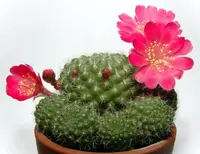
Red crown cactus (Rebutia minuscula) is a small, clustering cactus from the highlands of Argentina and Bolivia. It forms tight mounds of rounded stems covered in fine, regular spines.
In spring or early summer, it produces striking red to orange funnel-shaped flowers that almost hide the stems. The plant stays compact, which makes it suitable for windowsills and small containers.
Its slow growth, drought tolerance, and ability to handle indoor conditions make it relatively easy for beginners. Understanding how to care for Red Crown Cactus mainly involves giving bright light, fast-draining soil, and avoiding excess water.

Care Difficulty
Easy Care

Light Preference
Full Sun

Water Requirements
Low Water

Temperature Preference
Warm Climate

Hardiness Zone
9–11

Soil Texture
Sandy, Loamy, Rocky

Soil pH
Slightly acidic (6.5–7.0), Neutral (7.0)

Soil Drainage
Well-drained

Fertilization
Minimal (feed rarely)
Scan your plant to receive care tips personalized for your specific plant
Available on iOS and Android
This small cactus prefers bright, indirect light with some direct sun for compact, healthy growth.
Rebutia minuscula needs infrequent but thorough watering that fully wets the root zone, followed by a dry period.
This cactus prefers warm days, cool nights, and a distinct cooler rest period in winter.
This cactus prefers relatively dry air and usually stays healthy in 30–50% humidity.
Rebutia minuscula needs a very fast-draining, mineral-rich cactus mix to prevent root rot.
This species is highly suitable for container growing due to its small, clustering habit.
Rebutia minuscula benefits from light, controlled feeding during its active growing season.
Rebutia minuscula needs minimal pruning, focused mainly on health and appearance rather than shaping.
Red Crown Cactus grows best when slightly root bound, so repotting is infrequent but still important over time.
Rebutia minuscula is commonly multiplied from offsets and seeds under warm, bright conditions.
Rebutia minuscula needs a cool, dry winter rest to stay healthy and flower well the following season.

Plant Health Check
Not sure what's wrong with your plant? Check your plant's health inside the app.
This species is native to northwestern Argentina, where it naturally grows on rocky slopes and outcrops at higher elevations with strong light, cool nights, and well-drained mineral soils.
Mature plants form tight clusters of many small, spherical stems, an adaptation that helps reduce water loss and buffers temperature fluctuations in their native habitat.
The plant often produces bright red to orange flowers in a circular band around the sides of each stem, rather than only at the top, creating a characteristic crown-like display that inspired its common name red crown cactus.

Rebutia minuscula was among the early South American cacti widely introduced into European cultivation in the early 20th century, and its ease of flowering in small pots helped make the genus Rebutia popular in collections worldwide.
Flowering is often reduced by insufficient light, a lack of cool winter rest, or excess nitrogen fertilizer. Allow a cooler, drier winter period, then resume normal watering and feeding in spring to stimulate bud formation.
Keep your plants happy and healthy with plant identification, disease detection, and easy care guidance.

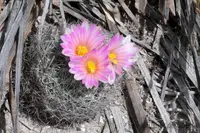
Rapicactus beguinii
Rapicactus beguinii
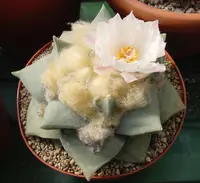
Ariocarpus retusus
Ariocarpus retusus
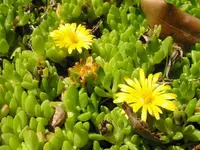
Delosperma nubigenum
Delosperma nubigenum
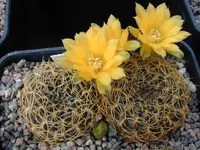
arenaceous crown cactus
Rebutia arenacea
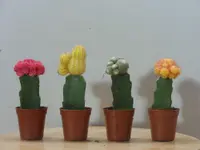 POPULAR
Moon Cactus
Gymnocalycium mihanovichii
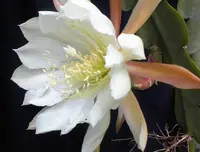
crenate orchid cactus
Disocactus crenatus
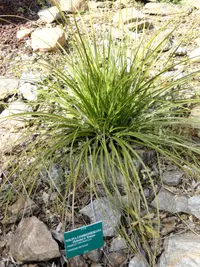
devil's shoestring
Nolina lindheimeriana

Matucana madisoniorum
Matucana madisoniorum