
common buckthorn Identification (Rhamnus cathartica)

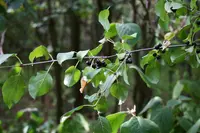
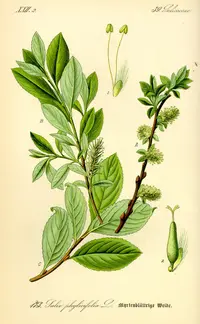
To recognize common buckthorn, look for opposite to subopposite, oval leaves with fine serrations and 3 to 4 pairs of strongly curved side veins. Twigs often end in a short spine.

It usually grows as a dense, many-branched shrub or small tree, with leaves clustered along short spur shoots.

Rhamnus cathartica Identification

Check Your Plant with Botan

Check your plant ID by uploading a clear photo to Botan.

Clear images work best. Avoid photos taken too close or too far away

Use a few easy traits to check for common buckthorn.

  • Twigs often end in a short, stiff spine.
  • Leaves are simple, oval, and mostly opposite or nearly opposite on the twig.
  • Leaf blades are about 1-2.5 inches (2.5-6 cm) long with fine teeth and 3-4 pairs of curved side veins.
  • Small greenish flowers have 4 petals and 4 sepals.
  • Fruits are round, black berries about 1/4 inch (6 mm) wide, usually holding 3-4 seeds.

Check several twigs, since leaf arrangement can vary on the same plant.

Rhamnus cathartica shows clear visual shifts from thorny sapling to flowering, fruiting shrub or small tree.

  • Young plant: Young plants are upright and twiggy, often with opposite or subopposite leaves and short spine-tipped branchlets that make the outline look stiff.
  • Mature plant: Mature plants become dense, many-branched shrubs or small trees, often 6-20 feet (1.8-6 m) tall, with gray bark and more obvious thorn-tipped branch ends.
  • Flowering stage: Flowers are small, yellow-green, and clustered where leaves join the twigs, adding many inconspicuous dots rather than changing the plant’s overall form.
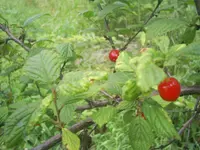
  • Fruiting stage: Fruiting branches carry round berries that turn black and sit in small clusters along the twigs, standing out clearly against the foliage.

In spring, common buckthorn leafs out early and may show small yellow-green flowers along the stems. By late summer into fall, clusters of round berries turn from green to black and often remain visible as leaves begin to yellow. After leaf drop, the dense twigging and short thorn-tipped branch ends stand out more clearly, which can make winter identification easier.

Several shrubs and small trees are often mistaken for common buckthorn.

glossy buckthorn(Frangula alnus)

Confused because both have oval leaves and dark berries. Glossy buckthorn lacks the thorn at twig tips, and its leaf margins are usually smooth rather than finely toothed.

Carolina buckthorn(Frangula caroliniana)

Similar in leaf shape and fruit. Carolina buckthorn has alternate leaves, not mostly opposite or subopposite pairs, and it lacks the sharp terminal spine.

black cherry(Prunus serotina)

Seedlings can resemble it by leaf shape and fine teeth. Black cherry has alternate leaves and longer, narrower blades, often with obvious arched side veins.

Rhamnus cathartica is native to much of Europe, western Asia, and parts of North Africa. In its native range, it is typically found in woodland edges, hedgerows, scrub, open woods, and disturbed ground rather than deep forest or wetland. That setting helps with identification because it often appears as a shrub or small tree in sunny to partly shaded thickets, fence lines, and calcareous landscapes. Finding it in dry to moderately moist edge habitat can help narrow the ID.

  • Toxic berries and seeds: The black berries and seeds are poisonous if eaten by humans and pets. Ingestion is the main concern.
  • Bark and leaves: The bark and leaves also contain harmful compounds. Ingestion can affect humans and pets, though berries create the most common risk.
  • Spines: Short thorn-tipped branch ends can puncture skin during handling. This is a physical injury risk rather than a poisoning risk.

Check Your Plant ID

Use Botan to identify or confirm it from a photo, which helps avoid mix-ups before you label, remove, or report it.

FAQ

A strong clue for common buckthorn identification is the short thorn at many twig tips, paired with glossy, oval leaves that have 3 to 5 curved vein pairs and mostly fine, rounded teeth.

More Plant Identification Guides

Identify Your Plant with Botan

Upload a photo to identify it, then get species-specific plant details, care information, and safety notes.

Botan app identifying a plant from a photo
What Do Plants Need to Grow – 5 Things Every Greenery Can't Live Without

8 min read · 31 Jul 2026

What Do Plants Need to Grow – 5 Things Every Greenery Can't Live Without

To keep plants healthy and thriving, provide the right balance of light, humidity, nutrients, airflow, and quality soil. This guide covers the essentials of year-round plant care.

Beginner Guides
What Do Plants Need to Grow – 5 Things Every Greenery Can't Live Without
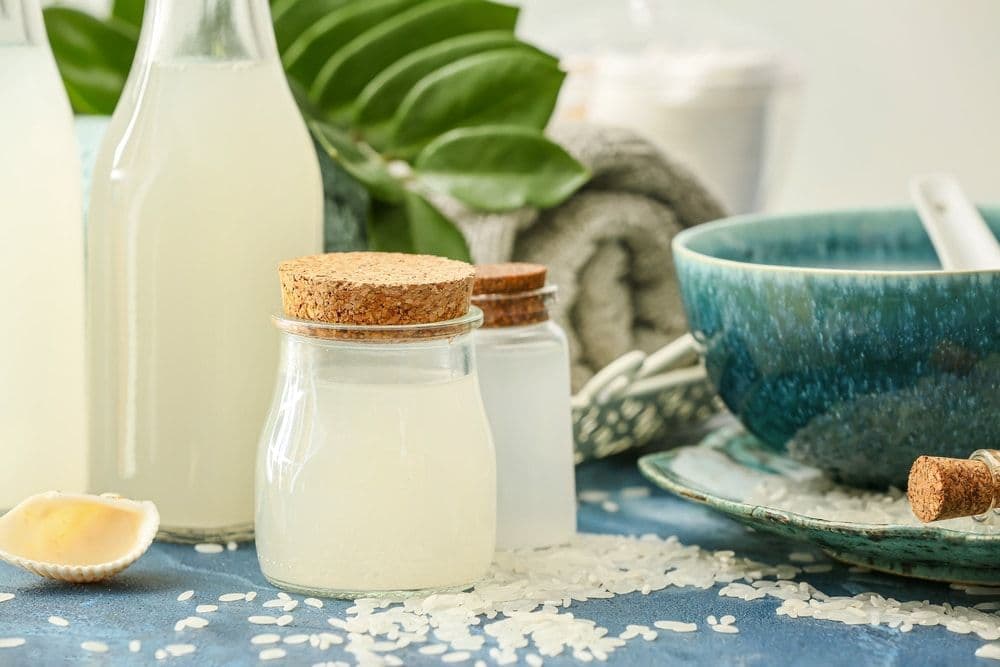
Rice Water for Plants – Which Plants Love It and How to Make It

8 min read · 14 Jul 2026

Rice Water for Plants – Which Plants Love It and How to Make It

Rice water can be an ideal DIY solution for orchids, roses, or fruiting plants. It supports growth, leaf count, and height. We’ll share how to make and apply it correctly for your plant.

Plant Care
Rice Water for Plants – Which Plants Love It and How to Make It
How to Mist Plants – Proper Technique and Common Mistakes

7 min read · 30 Jul 2026

How to Mist Plants – Proper Technique and Common Mistakes

Find out when misting works well and when to avoid it. Here, you’ll find detailed information about compatible and incompatible species, tips on how often to mist plants and do it correctly, and some great alternatives for raising humidity.

Beginner Guides
How to Mist Plants – Proper Technique and Common Mistakes