

Use Stable Substrate
Attach the moss to rough, inert materials like lava rock, unglazed clay, or hardwood using cotton thread or fine mesh so the shoots can anchor securely and form dense carpets rather than slipping or washing away.

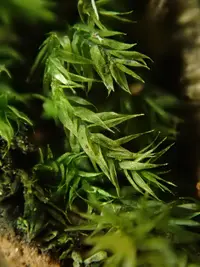
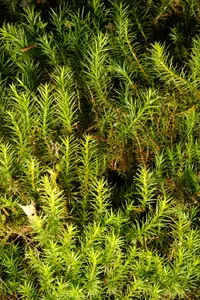
Clustered feather-moss, Rhynchostegium confertum, is a small, evergreen moss that forms dense, soft mats of fine, feathery stems. It often appears bright to yellow-green and creates a carpet-like ground cover.
In nature it grows on soil, rocks, rotting wood, and tree bases in moist, shaded woodlands and along stream banks, mainly in temperate regions. Its compact growth and ability to cling to surfaces make it useful in terrariums, bonsai displays, and naturalistic plantings.
Rhynchostegium confertum prefers consistent moisture, high humidity, and indirect light, which makes it sensitive to drying out. Once its needs are understood, it is fairly straightforward to care for Clustered Feather-moss in controlled indoor or outdoor setups.

Care Difficulty
Moderate Care

Light Preference
Partial Shade

Water Requirements
Keep Soil Moist

Temperature Preference
Cool Climate

Hardiness Zone
Unknown

Soil Texture
Loamy, Peaty, Organic-rich

Soil pH
Acidic (5.5–6.5)

Soil Drainage
Moist but well-drained

Fertilization
Minimal (feed rarely)
Scan your plant to receive care tips personalized for your specific plant
Available on iOS and Android
This moss thrives in low to moderate light that mimics a shaded forest floor.
This moss prefers constantly moist conditions without stagnant water.
This moss is adapted to cool to mild climates with moderate seasonal shifts.
This moss prefers consistently moist air and dries out quickly in low humidity.
Rhynchostegium confertum anchors best in moist, organic-rich, well-aerated substrates rather than dense mineral soil.
This species adapts well to shallow container culture when moisture and stability are controlled carefully.
This moss needs only minimal nutrition, as Rhynchostegium confertum is adapted to low-nutrient habitats.
Pruning is light and mainly cosmetic for Rhynchostegium confertum.
This moss is usually transplanted rather than repotted, since it forms surface mats rather than deep roots.
Propagation of this moss is straightforward and based on dividing and reattaching small mats.
Rhynchostegium confertum is generally cold hardy and needs little specific winter care outdoors.

Plant Health Check
Not sure what's wrong with your plant? Check your plant's health inside the app.
This moss frequently forms dense, low carpets on shaded forest floors and rotting logs in temperate Europe and parts of Asia, often dominating the bryophyte layer where soils stay moist but not waterlogged.
Its stems can creep along substrates and branch repeatedly, allowing it to colonize irregular surfaces such as tree bases, rocks, and decaying wood while maintaining a tightly packed, feather-like appearance.
As a typical acrocarpous moss, it produces upright sporophytes that release lightweight spores, which help it spread over short to moderate distances in suitable woodland habitats.
Growth is generally slow to moderate. Under stable moisture and cool, shaded conditions, new shoots may extend a few millimeters per month, gradually forming dense mats over several seasons rather than filling an area in a single year.
Keep your plants happy and healthy with plant identification, disease detection, and easy care guidance.

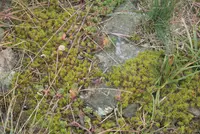
Sand-hill Screw-moss
Syntrichia ruraliformis
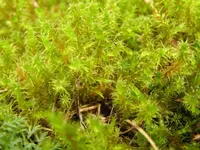
square goose neck moss
Rhytidiadelphus squarrosus
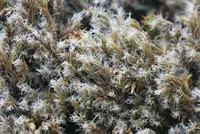
racomitrium moss
Racomitrium lanuginosum
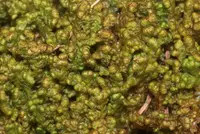
Northern Naugehyde Liverwort
Ptilidium ciliare
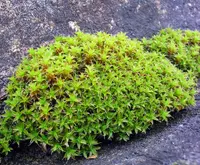
great hairy screw-moss
Syntrichia ruralis
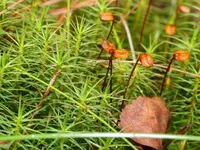
Common Haircap Moss
Polytrichum commune
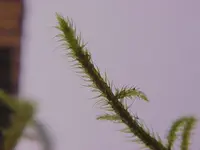
goose neck moss
Rhytidiadelphus loreus
Bank Haircap Moss
Polytrichum formosum