Secure To Hardscape
Gently tie or pin small tufts to rock, wood, or mesh with fine fishing line or plant thread for 2–4 weeks so the thalli can attach firmly and form a dense mat without floating away.

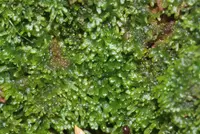
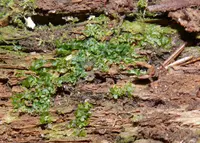
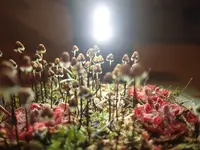
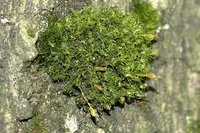
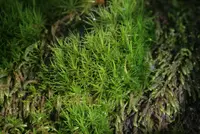
Palmate germanderwort (Riccardia palmata) is a small, finely branched liverwort often grown as a foreground or accent plant in aquariums and terrariums. It forms dense, cushion-like mats of delicate, palm-shaped fronds that creep over hardscape, rock, or wood.
In nature it grows on moist rocks, decaying wood, and stream margins in cool, shaded habitats across parts of Europe, Asia, and North America. Its slow but steady growth, compact size, and tolerance of constant moisture make it manageable but slightly demanding.
Stable humidity, gentle water movement, and low to moderate light support healthy development, so learning how to care for palmate germanderwort mainly involves keeping conditions consistently cool, shaded, and damp without strong drying airflow.

Care Difficulty
Hard Care

Light Preference
Shade

Water Requirements
Aquatic

Temperature Preference
Cool Climate

Hardiness Zone
Unknown

Soil Texture
Silty, Peaty, Organic-rich

Soil pH
Acidic (5.5–6.5)

Soil Drainage
Waterlogged tolerant

Fertilization
Minimal (feed rarely)
Scan your plant to receive care tips personalized for your specific plant
Available on iOS and Android
This small aquatic liverwort needs low to moderate light that mimics shaded stream or aquarium environments.
This species requires constantly wet conditions and does not tolerate drying out.
This liverwort prefers cool, stable conditions similar to shaded streams or mild aquaria.
This liverwort needs consistently high humidity to stay compact and healthy.
This species grows best on consistently wet, fine-textured, organic-rich substrates rather than typical potting soil.
This species is suitable for container culture, especially in shallow aquaria or closed terrariums.
Riccardia palmata is a low-nutrient liverwort that needs only very light feeding under culture.
Riccardia palmata benefits from light trimming to maintain dense, healthy mats in culture.
This liverwort is usually attached to hardscape rather than repotted, but it can be moved or reset when growth declines.
Riccardia palmata is commonly propagated vegetatively from small thallus fragments rather than from spores.
This liverwort is usually grown indoors or submerged and generally needs minimal specific winter care.

Plant Health Check
Not sure what's wrong with your plant? Check your plant's health inside the app.
This tiny liverwort often forms low, irregular cushions in cool, shaded stream margins and constantly moist rock crevices, showing a strong preference for stable, humid microclimates in clean waters.
Its thallus repeatedly forks into flattened, palm-like lobes with irregular side branches, a distinctive pattern that gives rise to the name palmata and helps increase surface area for gas exchange and water absorption.
Because it lacks protective cuticle and roots, this species reacts quickly to changes in water chemistry and can be absent from polluted sites, so its presence is often used as a sign of relatively unpolluted, stable freshwater habitats.

This species has a disjunct distribution, occurring both in parts of Europe and North America, which has made it a useful subject in studies on bryophyte biogeography and how small non-vascular plants colonize distant regions over long timescales.
This species usually performs best in consistently moist, shaded outdoor environments such as terrariums, shaded rockwork, or stream edges. Indoors, conditions are harder to keep stable, so many growers use closed terrariums or paludariums for reliable results.
Keep your plants happy and healthy with plant identification, disease detection, and easy care guidance.