Windfirm staking
Install 2–3 sturdy stakes and use soft, wide ties to secure the main stem and major side branches early in the season so the tall, sail-like canopy does not snap in strong wind.

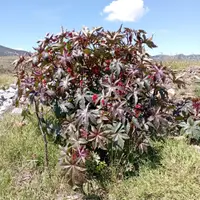
The castor oil plant, Ricinus communis, is a fast-growing ornamental shrub or small tree known for its bold, glossy leaves and dramatic presence. It often has red-tinged stems and seed pods, giving a strong architectural look in gardens.
This species is native to parts of Africa but is now grown in many warm and subtropical regions worldwide. It is generally easy to grow outdoors in suitable climates, as it tolerates heat and grows quickly from seed.
However, it requires careful placement because all parts, especially the seeds, are highly toxic. Those who care for castor oil plant should provide sun, regular moisture, and well-draining soil to keep it healthy and controlled.

Care Difficulty
Moderate Care

Light Preference
Full Sun

Water Requirements
Moderate Water

Temperature Preference
Tropical / Frost Sensitive

Hardiness Zone
9–11

Soil Texture
Sandy, Loamy, Organic-rich

Soil pH
Acidic (5.5–6.5), Slightly acidic (6.5–7.0)

Soil Drainage
Well-drained

Fertilization
Light (every 4–6 weeks)
Scan your plant to receive care tips personalized for your specific plant
Available on iOS and Android
This fast-growing species needs strong light to build sturdy stems and large leaves.
This plant prefers consistently moist but not waterlogged soil during its active growing season.
This warm-season species grows best in stable, frost-free conditions.
Humidity is rarely a limiting factor for Ricinus communis when grown outdoors in typical US climates.
Ricinus communis prefers deep, well-drained, fertile soil that stays evenly moist but never waterlogged.
This species can be grown in large containers outdoors if the pot is chosen to manage its fast growth and tall, top-heavy habit.
Nutrient-rich soil supports rapid Ricinus communis growth, especially in its first season.
Pruning Ricinus communis is mainly used to manage size and remove damaged growth.
Ricinus communis is usually grown as an annual in the ground, so transplanting young plants correctly is more important than long-term repotting.
Ricinus communis is most commonly grown from seed rather than vegetative methods.
In most temperate climates Ricinus communis behaves as a frost-tender annual and does not overwinter outdoors.

Plant Health Check
Not sure what's wrong with your plant? Check your plant's health inside the app.
The seeds contain ricin, a highly toxic protein that can be lethal to humans and animals if chewed and swallowed, while the extracted commercial castor oil is safe because ricin does not dissolve in oil.
In warm climates this species can grow from seed to a shrub or small tree several meters tall in a single season, which is unusually rapid for a woody plant.
The species is native to northeastern Africa and parts of the Middle East, but has naturalized across many tropical and subtropical regions of the world, often colonizing disturbed or abandoned land quickly.

Castor oil from this plant was already widely used in ancient Egypt, where archaeological evidence shows it was burned in lamps and applied as a component in ointments and cosmetics more than 3,000 years ago.
Brown, crispy edges usually come from underwatering, hot dry wind, or excess fertilizer salts. Check soil moisture, flush the pot occasionally, and shield from strong drying winds to stabilize Ricinus communis care and leaf quality.
Keep your plants happy and healthy with plant identification, disease detection, and easy care guidance.