Host tree selection
Establish the fungus only near compatible broadleaf hosts such as oak, beech, or chestnut, since the mycorrhizal partnership with these trees is essential for long-term fruiting.

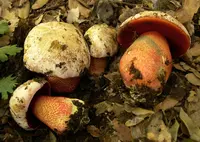
Rubroboletus rhodoxanthus, commonly called the ruddy bolete, is a fleshy, ectomycorrhizal fungus, not a leafy plant. It forms thick, club-shaped fruiting bodies with a pale cap flushed red, yellow pores that bruise blue, and a stout, often reddish stem.
This species is native to parts of Europe and occurs in warm, calcareous woodlands, typically in association with broadleaf trees such as oaks and beeches. It is considered rare and quite demanding in cultivation because it depends on a close partnership with suitable host tree roots and specific soil conditions.
Due to its strict habitat needs and mycorrhizal lifestyle, most guides advise observation in nature rather than attempting to care for ruddy bolete at home.

Care Difficulty
Hard Care

Light Preference
Partial Shade

Water Requirements
Keep Soil Moist

Temperature Preference
Cool Climate

Hardiness Zone
Unknown

Soil Texture
Loamy, Sandy, Organic-rich

Soil pH
Acidic (5.5–6.5)

Soil Drainage
Moist but well-drained

Fertilization
Minimal (feed rarely)
Scan your plant to receive care tips personalized for your specific plant
Available on iOS and Android
This ectomycorrhizal mushroom prefers dappled woodland light rather than full, open sun.
This woodland fungus depends on consistently moist, but not waterlogged, soil around its host tree roots.
This species fruits best in mild to warm conditions typical of late summer and early autumn in temperate woodlands.
Humidity is not a meaningful care factor for Rubroboletus rhodoxanthus, as it is a wild ectomycorrhizal fungus rather than a cultivated houseplant or garden plant.
Rubroboletus rhodoxanthus is not realistically cultivated, but understanding its natural soil conditions helps assess suitable woodland habitats.
This species is not suitable for container growing, as it depends on complex root associations with living trees in natural ground.
This ectomycorrhizal fungus relies on its tree partners and usually does not need direct fertilization.
Rubroboletus rhodoxanthus is a wild ectomycorrhizal fungus and is not pruned in the conventional horticultural sense.
This species is not suited to container culture; focus on establishing and moving its tree hosts rather than the fungus itself.
Propagation of this fungus is specialized and rarely done by home growers, relying on spore dispersal and tree root associations.
This wild bolete is naturally cold hardy in its native range and usually needs no intentional winter care from gardeners.

Plant Health Check
Not sure what's wrong with your plant? Check your plant's health inside the app.
The fruiting bodies contain toxic compounds that cause strong gastrointestinal upset when eaten, and there is no evidence that cooking removes this toxicity reliably, so it is considered a poisonous bolete in modern field guides.
When the flesh or pores are bruised or cut, they often show a distinct blue staining reaction caused by oxidation of pulvinic and other pigment-related compounds, a common but diagnostically important trait in this group of boletes.
This species forms ectomycorrhizal partnerships with broadleaf trees such as oaks and beeches, exchanging mineral nutrients and water from the soil for sugars produced by the host through photosynthesis.

This species is considered rare or very local in much of its European range and is listed in several regional Red Data Books, making habitat protection for its associated oak and beech woodlands important for its long-term survival.
This species is considered poisonous and must not be eaten, even if cooked. It contains gastrointestinal toxins that can cause severe stomach pain, nausea, vomiting, and diarrhea. Identification mistakes with edible boletes are also very common.
Keep your plants happy and healthy with plant identification, disease detection, and easy care guidance.