Two-wire support
Install a simple two-wire fence or trellis at 45–90 cm and 120–150 cm heights, then tie in new canes loosely with soft ties to keep the plant upright, improve air movement, and make pruning and harvesting safer and easier.

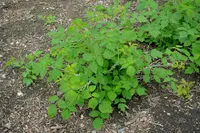
Rubus biflorus, often called the ghost bramble or white-stemmed bramble, is a deciduous shrub from the rose family. It is mainly native to the Himalayas and western China.
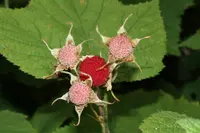
The plant is valued for its striking white, bloom-covered winter stems and arching, upright habit that forms a thicket over time. In summer it produces green foliage and small white flowers, followed by ornamental but usually sparse fruits.
Gardeners care for Rubus biflorus primarily as an architectural shrub for winter interest rather than for heavy fruiting. It is generally robust and easy to grow in temperate climates, preferring sun to light shade and well-drained, moderately moist soil.

Care Difficulty
Easy Care

Light Preference
Full Sun

Water Requirements
Moderate Water

Temperature Preference
Cold Hardy

Hardiness Zone
5–8

Soil Texture
Loamy, Sandy, Organic-rich

Soil pH
Acidic (5.5–6.5), Slightly acidic (6.5–7.0)

Soil Drainage
Moist but well-drained

Fertilization
Minimal (feed rarely)
Scan your plant to receive care tips personalized for your specific plant
Available on iOS and Android
This shrub performs best in open, bright positions with cool roots and good air movement.
This species prefers consistently moist, free-draining soil rather than frequent shallow watering.
This hardy bramble is adapted to cool to temperate outdoor conditions with marked seasonal change.
This species tolerates a wide humidity range and usually does not need special humidity management outdoors.
Rubus biflorus prefers deep, moist, well-drained loam with plenty of organic matter for strong cane and root development.
This vigorous shrub is only moderately suitable for container growing and needs large, stable containers to perform well.
This shrub is adaptable and needs only modest feeding in typical garden soil.
Thoughtful pruning keeps Rubus biflorus healthy, compact, and ornamental.
This species is usually grown in the ground, so focus on correct planting and occasional transplanting.
Rubus biflorus is commonly propagated to expand clumps or renew aging plantings.
This shrub is cold hardy in most temperate gardens and usually needs minimal winter care.

Plant Health Check
Not sure what's wrong with your plant? Check your plant's health inside the app.
Mature canes develop a dense white, waxy bloom over purplish-brown bark, giving a striking ghostly appearance in winter when leaves are absent. This bloom is a protective coating that reduces water loss and reflects light, especially visible in cold, bright conditions.
Like many raspberries, it forms vegetative primocanes in the first year and flowering floricanes in the second year, after which those canes die. This biennial cane pattern influences pruning, because only second-year canes carry flowers and fruits.
Despite originating in the Himalayas and western China, it is notably cold-hardy and is grown reliably in many temperate climates. The combination of Himalayan origin and tolerance to frost makes it valuable for extending the ornamental season in colder gardens.
This species spreads by suckering canes and can form dense thickets over time. In fertile soil it may become vigorous, so use root barriers, regular pruning, and removal of unwanted shoots to keep it within bounds.
Keep your plants happy and healthy with plant identification, disease detection, and easy care guidance.