Cane training
Install low wires or a simple trellis and loosely tie new canes horizontally in late spring to improve light exposure, airflow, and fruiting along the full length of each stem.

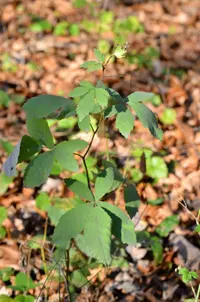
Rubus canescens is a perennial bramble in the rose family, related to raspberries and blackberries. It forms arching, often thorny canes and a low, spreading thicket. Leaves are typically divided and softly hairy, giving the plant a slightly grayish or “canescent” look. Small white to pale pink flowers develop into aggregate fruits that resemble small blackberries. This species is native to parts of Europe and western Asia, where it grows in open woodland edges, scrub, and sunny slopes. It can spread vigorously in suitable conditions, so it is usually better suited to naturalistic or wild areas than tight garden beds. Those who want to care for Rubus canescens should know it prefers sun to light shade, reasonably moist but well-drained soil, and room to expand.

Care Difficulty
Moderate Care

Light Preference
Full Sun

Water Requirements
Moderate Water

Temperature Preference
Cold Hardy

Hardiness Zone
5–8

Soil Texture
Sandy, Loamy, Rocky

Soil pH
Acidic (5.5–6.5), Slightly acidic (6.5–7.0)

Soil Drainage
Well-drained

Fertilization
Minimal (feed rarely)
Scan your plant to receive care tips personalized for your specific plant
Available on iOS and Android
This bramble prefers bright outdoor conditions with moderate direct sun exposure.
This species prefers consistently moist but not saturated soil, especially during active growth.
This hardy bramble tolerates a wide temperature range but grows best in mild conditions.
This species handles a wide humidity range but grows best in moderate outdoor air moisture.
Rubus canescens prefers loose, well-aerated mineral soil that stays moist but not waterlogged.
This species can be grown in containers outdoors for controlled spread and easier management.
This wild bramble generally needs minimal feeding in ordinary garden soil.
Pruning keeps Rubus canescens manageable and encourages healthy, productive canes.
This species is usually grown in the ground, so focus on careful transplanting rather than frequent repotting.
Rubus canescens is commonly propagated to expand groundcover patches or maintain selected forms.
This bramble is generally cold hardy and needs only basic winter care in most temperate gardens.

Plant Health Check
Not sure what's wrong with your plant? Check your plant's health inside the app.
This species often shows a fine, pale grey felt-like coating on the undersides of its leaves, which contributes to its species name canescens, meaning becoming grey or hoary. The hairs help reduce water loss and can slightly reflect strong sunlight in its typically open habitats.
Rubus canescens is characteristically associated with calcareous, lime-rich substrates, especially in dry to moderately moist habitats. It is frequently found on limestone slopes, rocky grasslands, and light woodland edges where many other brambles are less competitive.
This species belongs to the Rubus fruticosus aggregate, a group known for frequent hybridization and apomixis, which is a form of asexual seed production. As a result, its delimitation and relationship to closely allied micro-species have been the subject of repeated taxonomic revisions.
This bramble spreads by arching canes and suckering roots, forming patches over time. In suitable conditions it can become vigorous, so use edging, root barriers, or regular cutting back if a contained planting area is desired.
Keep your plants happy and healthy with plant identification, disease detection, and easy care guidance.