Timed deadheading
Remove spent flowers weekly during peak bloom by cutting just above a leaf node to extend flowering and keep plants from exhausting themselves setting seed too early.

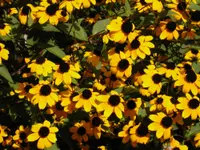
Browneyed Susan (Rudbeckia triloba) is a short-lived perennial or biennial wildflower grown mainly as a long-blooming ornamental. It forms branching stems topped with many small, dark-centered yellow daisylike flowers. Plants often reach a bushy, open shape that fits well in cottage gardens, prairie-style plantings, and naturalized borders. Rudbeckia triloba is native to central and eastern North America, where it grows in open woods, roadsides, and meadows. It is valued for its toughness, reseeding habit, and ability to attract pollinators. Gardeners usually find it easy to grow in full sun, with moderately moist, well-drained soil. These traits make it straightforward to care for browneyed Susan in many home gardens.

Care Difficulty
Easy Care

Light Preference
Full Sun

Water Requirements
Moderate Water

Temperature Preference
Cold Hardy

Hardiness Zone
4–8

Soil Texture
Sandy, Loamy, Clay

Soil pH
Acidic (5.5–6.5), Slightly acidic (6.5–7.0)

Soil Drainage
Moist but well-drained

Fertilization
Minimal (feed rarely)
Scan your plant to receive care tips personalized for your specific plant
Available on iOS and Android
Rudbeckia triloba grows best in bright outdoor conditions with strong direct sun.
Rudbeckia triloba prefers consistently moist but not waterlogged soil once established outdoors.
This species is a hardy perennial that tolerates a wide range of outdoor temperatures in temperate climates.
This species grows well in typical outdoor humidity and rarely needs special moisture management.
Rudbeckia triloba prefers moderately fertile, well-drained ground that still holds some moisture.
This species can grow in containers for a season if the pot supports its tall, branching habit.
This North American native Rudbeckia triloba usually needs only modest feeding in average garden soil.
Pruning Rudbeckia triloba helps maintain a tidy shape and can extend the flowering period.
This species is most often grown in garden beds, so focus on transplanting rather than frequent repotting.
Rudbeckia triloba is commonly propagated by seed and by division of mature clumps.
This hardy perennial usually needs minimal winter care in most temperate gardens.

Plant Health Check
Not sure what's wrong with your plant? Check your plant's health inside the app.
Rudbeckia triloba behaves as a short‑lived perennial or biennial, often flowering most heavily in its second year, then relying on abundant self‑seeding to maintain long‑term populations in the same spot.
The species name triloba refers to the frequently three‑lobed leaves on the middle and upper stems, a feature that helps distinguish it from the more common black‑eyed Susan, which usually has unlobed leaves.
Its small, numerous flower heads provide late‑season nectar and pollen for native bees and butterflies, while seed heads are eaten by finches and other small birds through autumn and winter.

This species is commonly used as a short‑term, fast‑establishing component in North American prairie restorations, where it quickly creates floral display and pollinator resources while longer‑lived prairie perennials are still maturing.
Poor flowering usually comes from too much shade, excess nitrogen fertilizer, or stressed, crowded roots. Ensure at least moderate sun, avoid high-nitrogen lawn fertilizers nearby, and divide or thin dense clumps every few years to restore flowering.
Keep your plants happy and healthy with plant identification, disease detection, and easy care guidance.