

Encourage Compact Form
Rotate containers by 90° every 2–3 weeks so light reaches all sides evenly, which keeps the plant low, dense, and prevents lopsided, stretched growth when growing Sharp Tentfig.

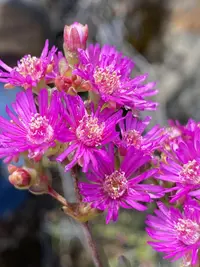
Sharp tentfig (Ruschia pungens) is a compact, mat-forming succulent from arid regions of South Africa. It belongs to the ice plant family and is adapted to strong sun and poor, rocky soils. The plant forms low cushions of small, triangular, pointed leaves that store water and often develop a slightly rough texture. In season it produces daisy-like flowers, usually in pink or magenta tones, that open in bright light. Ruschia pungens suits rock gardens, troughs, and containers where good drainage is essential. Its drought tolerance and slow, tidy growth habit make it relatively straightforward to care for Sharp Tentfig when overwatering is avoided.

Care Difficulty
Easy Care

Light Preference
Full Sun

Water Requirements
Low Water

Temperature Preference
Warm Climate

Hardiness Zone
9–11

Soil Texture
Sandy, Loamy, Rocky

Soil pH
Slightly acidic (6.5–7.0), Slightly alkaline (7.0–7.5)

Soil Drainage
Well-drained

Fertilization
Minimal (feed rarely)
Scan your plant to receive care tips personalized for your specific plant
Available on iOS and Android
This compact South African succulent thrives in strong light and needs several hours of direct sun daily.
This drought-adapted succulent prefers infrequent, deep watering and fast-drying soil.
This species prefers warm, dry conditions and has some tolerance to both heat and light frost.
This succulent prefers dry air and does not need extra humidity beyond typical indoor levels.
Ruschia pungens needs very fast-draining, mineral-based soil that dries quickly between waterings.
This species is well suited to container growing, especially in shallow, free-draining pots.
This drought-tolerant succulent has low nutrient needs, so use light feeding to support compact growth and flowering in Sharp Tentfig.
Pruning Ruschia pungens is mainly used to maintain a low, tidy mat and encourage dense new shoots.
This succulent is usually grown in rock gardens or shallow containers and dislikes frequent disturbance.
Expansion of Ruschia pungens is commonly done from short stem cuttings rather than seed.
Mature plants tolerate light frost but benefit from simple measures in colder or wetter winters.

Plant Health Check
Not sure what's wrong with your plant? Check your plant's health inside the app.
This species has sharply pointed, succulent stems that act as both leaves and water-storage organs, an adaptation to its arid South African habitat.
Ruschia pungens often grows among quartz gravel and rocky slopes in the Western Cape, where the pale stones help reflect light and reduce temperature stress around its roots.
The plant forms hard, woody seed capsules with specialized silica bodies that help the capsules maintain shape and open reliably when moistened by rain.
This species forms low, spreading mats but is not usually aggressive in well-drained, low-fertility sites. It expands slowly by branching stems. Occasional trimming of edges keeps it neatly contained in rock gardens or between paving.
Keep your plants happy and healthy with plant identification, disease detection, and easy care guidance.

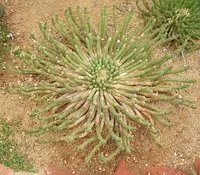
Porcupine Vingerpol
Euphorbia inermis
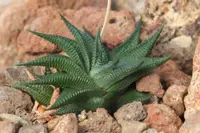
Fairy Washboard
Haworthiopsis limifolia
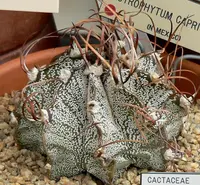
Goat's Horn Cactus
Astrophytum capricorne
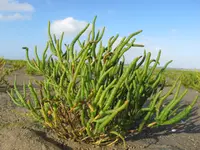
long-spiked glasswort
Salicornia procumbens
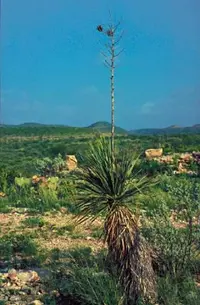
Buckley's yucca
Yucca constricta
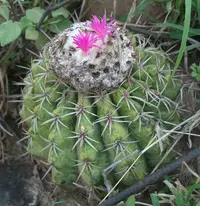
Melocactus curvispinus
Melocactus curvispinus

Salicornia ambigua
Salicornia ambigua
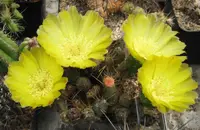
Maihueniopsis ovata
Maihueniopsis ovata