Salinity Management
Rotate irrigation with brackish and fresher water to mimic tidal fluctuation, keeping some salt exposure but occasionally leaching excess salts to prevent root burn in containers.

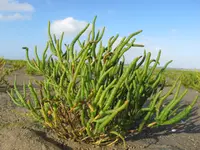
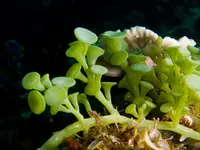
Salicornia ambigua is a small, fleshy, salt-tolerant plant often called a glasswort or samphire type, forming low, jointed, leafless stems. It grows naturally in coastal salt marshes and tidal flats, where it handles high salinity and periodic flooding.
Its stems are usually green and can turn reddish with age or stress, giving it a distinctive seasonal color change. The plant has a compact, spreading habit and stays relatively low to the ground.
Because it is adapted to saline, wet conditions, it can be challenging to grow away from coastal environments. Understanding how to care for Salicornia ambigua starts with providing strong light, regular moisture, and very well-drained, mineral-rich, often salty substrate.

Care Difficulty
Moderate Care

Light Preference
Full Sun

Water Requirements
Aquatic

Temperature Preference
Warm Climate

Hardiness Zone
8–11

Soil Texture
Sandy, Loamy

Soil pH
Neutral (7.0), Slightly alkaline (7.0–7.5)

Soil Drainage
Waterlogged tolerant

Fertilization
Minimal (feed rarely)
Scan your plant to receive care tips personalized for your specific plant
Available on iOS and Android
This coastal halophyte prefers strong light similar to open shoreline conditions.
This salt-marsh species prefers consistently moist conditions and tolerates brief flooding.
This species is adapted to mild, maritime climates with moderate seasonal variation.
This coastal halophyte tolerates a wide humidity range but prefers moderately moist air.
This salt-marsh species needs sandy, highly draining, saline substrate rather than typical garden soil.
This species adapts well to container culture when its unusual salt and drainage needs are met.
This coastal halophyte typically grows in nutrient-poor, saline habitats and needs no additional fertilizer in the ground.
This species needs only light, functional pruning to keep growth tidy and harvestable.
In cultivation, this plant is more often transplanted or up-potted than kept long term in the same container.
This salt-marsh annual or short-lived perennial is usually propagated from seed under controlled conditions.
In mild coastal climates, established plants are quite tolerant of cool, salty conditions and need minimal winter care.

Plant Health Check
Not sure what's wrong with your plant? Check your plant's health inside the app.
Salicornia ambigua is an annual halophyte that completes its life cycle in 1 season while tolerating salt concentrations similar to or higher than seawater, which is unusual even among salt marsh plants.
This species is native to coastal salt marshes and tidal flats from California into northwestern Mexico, and its natural distribution is restricted to the Pacific coast rather than being broadly cosmopolitan like several related Salicornia species.
It tends to occupy mid to high salt-marsh zones, often in slightly elevated, less frequently flooded microsites, which helps it avoid prolonged submergence while still accessing saline conditions it requires.
The species is generally regarded as edible and is often used as a salty vegetable or garnish. Only harvest from clean, unpolluted sites, and rinse well to remove surface salts and potential contaminants before consumption.
Keep your plants happy and healthy with plant identification, disease detection, and easy care guidance.