Host tree focus
Prioritize establishing or maintaining healthy beech or oak trees, since this fungus relies on a mycorrhizal partnership with these hosts to form stable fruiting bodies year after year.

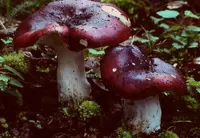
Purple brittlegill (Russula atropurpurea) is a woodland mushroom, not a true plant, known for its dark purple to wine-red cap and pale, brittle gills. It forms mycorrhizal partnerships with trees, meaning it exchanges nutrients with their roots in the soil.
This species is typically found in temperate forests, especially under beech and oak, often appearing in late summer to autumn. Caps flatten with age and the stems stay relatively stout and white.
Russula atropurpurea is not commonly cultivated, so attempts to care for Purple Brittlegill at home are challenging due to its reliance on living tree roots. It generally prefers undisturbed, moist, well-drained woodland soils with dappled light.

Care Difficulty
Hard Care

Light Preference
Partial Shade

Water Requirements
Regular Water

Temperature Preference
Cool Climate

Hardiness Zone
Unknown

Soil Texture
Loamy, Sandy, Organic-rich

Soil pH
Acidic (5.5–6.5)

Soil Drainage
Moist but well-drained

Fertilization
Minimal (feed rarely)
Scan your plant to receive care tips personalized for your specific plant
Available on iOS and Android
This woodland fungus prefers dappled light that mimics a mixed forest floor rather than open sun.
This mycorrhizal fungus depends on consistently moist, not saturated, forest soil rather than direct watering.
This species fruits best in cool to mild conditions typical of temperate woodlands.
Humidity is not a meaningful care factor because this mushroom fruits outdoors in natural forest air conditions.
This ectomycorrhizal mushroom depends on specific tree roots and cannot be grown in regular container or garden soil like a typical plant.
This species is not suitable for container growing because it requires a symbiotic relationship with tree roots in natural soil.
Russula atropurpurea is a wild ectomycorrhizal fungus that does not need direct fertilization when managed in naturalistic or forestry settings.
Russula atropurpurea does not form woody stems or long-lived foliage, so it does not benefit from pruning as a management practice.
This fungus partners with tree roots in soil and is not suited to typical container culture or frequent moving.
Russula atropurpurea is challenging to propagate intentionally because it depends on complex mycorrhizal relationships with host tree roots.
In-ground Russula atropurpurea is naturally cold hardy in its native range and needs no special winter protection in typical outdoor conditions.

Plant Health Check
Not sure what's wrong with your plant? Check your plant's health inside the app.
The cap of this species shows a wide color range from deep purple or wine red to almost blackish, often with paler or slightly mottled areas toward the margin, which helps distinguish it from more uniformly colored purple brittlegills.
It forms ectomycorrhizal partnerships with broadleaf trees, especially beech (Fagus species), exchanging mineral nutrients for sugars and playing a key role in nutrient cycling in temperate European woodlands.
Like other russulas, its gills and stem are composed of spherical cells called sphaerocysts, which make the flesh characteristically brittle so it snaps cleanly like chalk rather than bending.

Genetic and microscopic studies show that some collections once all identified as this species actually represent a small complex of closely related purple-capped russulas, which has led to taxonomic revisions and more careful use of microscopic features in identification.
This species is generally considered inedible or only marginally edible due to its brittle texture and sometimes acrid taste. Identification mistakes with similar, toxic Russula species are common, so consumption is not recommended for non-experts.
Keep your plants happy and healthy with plant identification, disease detection, and easy care guidance.