Contain Spore Splash
Place boards, plastic edging, or sacrificial mulch (like straw or bark chips) between this fungus and cars, siding, or pathways to catch the sticky spore masses before they reach hard-to-clean surfaces.

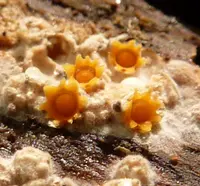
Cannonball fungus, Sphaerobolus stellatus, is a tiny, saprophytic fungus that lives on decaying wood, bark mulch, and plant debris rather than in soil like typical garden plants. It forms small, pale to orange-brown cups that suddenly shoot dark spore masses like miniature cannonballs, which can stick to nearby surfaces.
This species occurs widely in temperate regions, especially in mulched garden beds and shaded, moist landscapes. It is not commonly cultivated on purpose, and attempts to care for cannonball fungus usually focus on managing or preventing its spread rather than encouraging growth.
It thrives in consistently moist, organic-rich materials with moderate shade, making it more of an opportunistic colonizer than a traditional house or garden specimen.

Care Difficulty
Moderate Care

Light Preference
Partial Shade

Water Requirements
Keep Soil Moist

Temperature Preference
Cool Climate

Hardiness Zone
Unknown

Soil Texture
Loamy, Organic-rich

Soil pH
Slightly acidic (6.5–7.0), Neutral (7.0)

Soil Drainage
Moist but well-drained

Fertilization
Minimal (feed rarely)
Scan your plant to receive care tips personalized for your specific plant
Available on iOS and Android
This fungus prefers bright but indirect light conditions similar to lightly shaded garden beds or mulch around shrubs.
Sphaerobolus stellatus grows best in consistently moist but not waterlogged organic material such as wood chips or leaf litter.
This species favors mild, temperate conditions and often fruits most actively in cool, moist weather.
Humidity is not a key factor for Sphaerobolus stellatus, which copes well across a wide range.
Sphaerobolus stellatus develops best in consistently moist, organic-rich substrates that mimic decomposing wood or mulch.
This species is not well suited to container growing, as it naturally colonizes outdoor mulch, wood, and debris layers.
Sphaerobolus stellatus grows on nutrient-rich organic debris and usually needs no additional fertilization in gardens or pots.
Sphaerobolus stellatus does not respond to pruning like a typical ornamental plant and requires only minimal management.
This fungus is not managed through traditional repotting; instead, its substrate or host surface is adjusted when control or relocation is needed.
In gardens, Sphaerobolus stellatus spreads itself by shooting spores and is rarely propagated intentionally.
Outdoor populations of this fungus are cold hardy and usually need no special winter care.

Plant Health Check
Not sure what's wrong with your plant? Check your plant's health inside the app.
This fungus builds a tiny pressurized structure that shoots a spore-filled packet (peridiole) toward bright surfaces with remarkable accuracy, helping it reach new locations for growth.
The fruiting bodies are strongly phototropic, meaning they grow and orient toward light, so the spore packets are launched preferentially at sunlit, pale objects such as light-colored siding or cars.
Once the spore masses land, they dry into extremely sticky, dark specks that adhere firmly to surfaces and are notoriously difficult to remove without damaging paint or finishes.

Molecular and detailed morphological studies have placed this species in the small family Sphaerobolaceae, which is considered evolutionarily distinct within the Basidiomycota because of its highly specialized spore-shooting mechanism and miniature, star-shaped fruiting bodies.
This species spreads efficiently by shooting sticky spore masses onto nearby surfaces, especially light-colored siding, cars, pots, or mulch. It is not harmful to plants but can be a stubborn aesthetic nuisance in gardens and landscaped beds.
Keep your plants happy and healthy with plant identification, disease detection, and easy care guidance.