Host tree matching
Establish this mycorrhizal fungus near compatible hosts such as conifers or oaks, and avoid planting it in isolated lawn areas with no trees, since the fungus depends on tree roots for long-term survival.

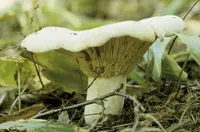
Short-stemmed russula (Russula brevipes) is a sturdy, fleshy mushroom, not a true plant, commonly found in conifer and mixed forests. It forms a thick, often funnel-shaped white cap with a short, solid stem and crowded white gills. This species grows mycorrhizal, meaning it lives in a mutual partnership with tree roots and cannot be raised in regular garden soil or containers. It is widespread across North America, especially in temperate, moist woodland habitats. Fungi enthusiasts often focus more on identification than on how to care for Short-stemmed Russula, since it depends strongly on its forest environment and host trees.

Care Difficulty
Hard Care

Light Preference
Partial Shade

Water Requirements
Regular Water

Temperature Preference
Cool Climate

Hardiness Zone
Unknown

Soil Texture
Loamy, Silty, Organic-rich

Soil pH
Strongly acidic (4.5–5.5), Acidic (5.5–6.5)

Soil Drainage
Moist but well-drained

Fertilization
Minimal (feed rarely)
Scan your plant to receive care tips personalized for your specific plant
Available on iOS and Android
This ectomycorrhizal fungus prefers cool, shaded forest conditions rather than open sun.
Russula brevipes depends on consistently moist, not waterlogged, forest soil to fruit well.
This forest fungus fruits best in cool to mild conditions and is sensitive to temperature extremes.
Humidity is not a practical care factor, as this ectomycorrhizal fungus cannot be managed like a typical cultivated plant.
Russula brevipes grows naturally in undisturbed forest soil rather than prepared mixes, so direct soil manipulation is usually neither practical nor effective.
This species is not suitable for container growing, because its survival depends on ectomycorrhizal partnership with living tree roots in undisturbed soil.
Russula brevipes is a wild mycorrhizal fungus that does not benefit from conventional fertilization and usually needs no added nutrients in garden or woodland settings.
Pruning is not a care practice for Russula brevipes, since it is a mushroom and not a woody or leafy plant.
This fungus grows in symbiosis with tree roots, so repotting or transplanting is not a standard or practical management step.
Propagation of Russula brevipes is handled naturally by spores and underground mycelium, and deliberate propagation at home is difficult.
Short-stemmed Russula is a cold-hardy woodland fungus that generally requires no special winter care in outdoor settings.

Plant Health Check
Not sure what's wrong with your plant? Check your plant's health inside the app.
This species is the primary host for the parasitic fungus Hypomyces lactifluorum, which transforms its white, thick-fleshed fruiting body into the bright orange, seafood-scented form sold as the lobster mushroom.
The cap and stem are unusually thick, heavy, and chalky-brittle compared with many other gilled mushrooms, which helps field mycologists distinguish it from similar white russulas and milkcaps.
This ectomycorrhizal fungus forms nutrient-trading root partnerships with many conifer species, especially in coastal and montane forests of western North America, where it can fruit in large, locally abundant patches.

Molecular studies have shown that collections once all called Russula brevipes actually represent a complex of closely related species, and some eastern North American material has been reassigned to different, cryptic taxa that look almost identical in the field.
This species is technically edible but often considered poor quality because the flesh is dense, bland, and can host parasitic fungi like Hypomyces lactifluorum. Only experienced foragers should collect it, and always cook thoroughly before eating.
Keep your plants happy and healthy with plant identification, disease detection, and easy care guidance.