

Mycelium-Friendly Handling
Mark and avoid stepping on known fruiting spots so the underground mycelium network is not compacted, which helps maintain reliable flushes when growing Winter Russula.

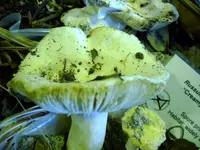
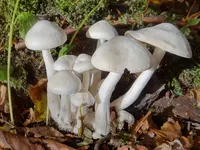
Winter Russula, Russula cremoricolor, is a small to medium-sized mushroom rather than a leafy houseplant. It typically has a creamy to pale cap, firm white gills, and a stout stalk, forming scattered or grouped fruiting bodies on the forest floor.
This species is usually found in temperate woodlands, often in association with coniferous or mixed forests, where it forms mycorrhizal partnerships with tree roots. These partnerships make it difficult to cultivate at home, so guides on how to care for Winter Russula focus mainly on understanding its natural woodland conditions. It prefers cool, moist, shaded habitats with undisturbed, humus-rich soil.

Care Difficulty
Moderate Care

Light Preference
Partial Shade

Water Requirements
Regular Water

Temperature Preference
Cool Climate

Hardiness Zone
Unknown

Soil Texture
Loamy, Sandy, Organic-rich

Soil pH
Acidic (5.5–6.5)

Soil Drainage
Moist but well-drained

Fertilization
Minimal (feed rarely)
Scan your plant to receive care tips personalized for your specific plant
Available on iOS and Android
This ectomycorrhizal fungus prefers cool, dappled forest light rather than direct, open sun.
This forest-dwelling fungus depends on consistently moist, but not saturated, soil and leaf litter.
This species favors cool to mild conditions typical of late fall and early winter woodlands.
Humidity has little direct impact on Russula cremoricolor because it is a wild, ectomycorrhizal mushroom rather than a typical houseplant.
This fungus grows in natural forest soils and is not managed like a potted plant, so soil preparation focuses on supporting its tree partners and native habitat.
This species is not suitable for container growing, as it relies on complex root partnerships with trees in living soil ecosystems.
Russula cremoricolor forms mycorrhizal partnerships with tree roots and normally does not benefit from direct fertilization.
Pruning is not applied to Russula cremoricolor because it is a wild ectomycorrhizal fungus, not a managed garden plant.
Transplanting this ectomycorrhizal fungus is rarely successful because Russula cremoricolor depends on complex root and soil relationships.
Intentional propagation of Russula cremoricolor is difficult and not a standard practice for home growers.
Winter Russula is naturally cold hardy in its native range and does not require dedicated winter care from gardeners.

Plant Health Check
Not sure what's wrong with your plant? Check your plant's health inside the app.
This species is native to North America and is most often recorded in the Pacific Northwest and parts of western Canada, where it is associated with conifer-dominated forests.
It forms ectomycorrhizal associations with conifer trees, meaning its fine underground threads wrap around tree roots and exchange mineral nutrients for sugars produced by the tree through photosynthesis.
Mature mushrooms show a pale cream to whitish cap with relatively firm, brittle flesh, which is typical for the genus but in this species combines with its distinct coloration to help field mycologists separate it from similar russulas.
This fungus is considered inedible. The flesh is brittle, often acrid or unpleasant in taste, and not recommended for consumption. Identification errors with similar toxic russulas are possible, so collecting it for food is unsafe.
Keep your plants happy and healthy with plant identification, disease detection, and easy care guidance.

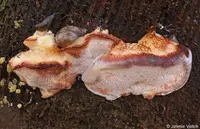
brown-staining cheese polypore
Fuscopostia fragilis
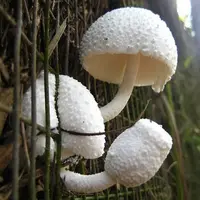
Leucocoprinus cretaceus
Leucocoprinus cretaceus
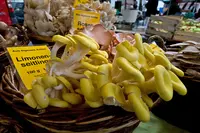
Golden Oyster Mushroom
Pleurotus citrinopileatus
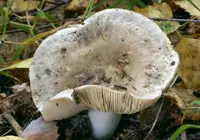
Blackening Russula
Russula adusta
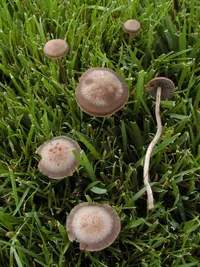
Mower's Mushroom
Panaeolus foenisecii
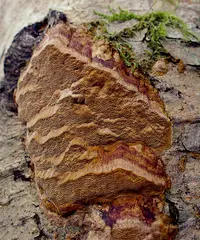
Rusty Porecrust
Fuscoporia ferruginosa
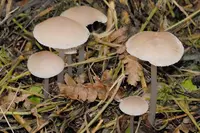
Snapping Bonnet
Mycena vitilis
White Domecap
Leucocybe connata