Retain Host Trees
Preserve or plant suitable host trees such as birch and related broadleaf species nearby, since this Russula forms essential mycorrhizal partnerships with their roots and will not fruit reliably without them.

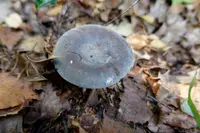
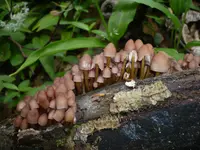
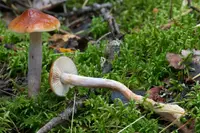
Powdery brittlegill (Russula parazurea) is a woodland mushroom, not a houseplant, known for its fragile, chalky cap and brittle white gills. It forms mycorrhizal associations, meaning it lives in partnership with tree roots, especially in mixed and deciduous forests.
Caps range from gray-blue to pale greenish tones with a fine, powdery surface, while the stem is usually white and easily snaps. It appears from late summer to autumn, often in groups on well-drained, leaf-littered soils.
Because it depends on specific tree partners and soil fungi, it is not realistic to care for Powdery Brittlegill as a typical cultivated plant. In nature it favors moist, cool, lightly shaded habitats with stable forest conditions.

Care Difficulty
Hard Care

Light Preference
Partial Shade

Water Requirements
Keep Soil Moist

Temperature Preference
Cool Climate

Hardiness Zone
Unknown

Soil Texture
Loamy, Sandy, Organic-rich

Soil pH
Acidic (5.5–6.5), Slightly acidic (6.5–7.0)

Soil Drainage
Moist but well-drained

Fertilization
Minimal (feed rarely)
Scan your plant to receive care tips personalized for your specific plant
Available on iOS and Android
This woodland fungus prefers cool, dappled light typical of mixed or deciduous forests.
This mycorrhizal fungus depends on consistently moist, well-drained forest soil rather than direct watering.
This species favors the mild to cool temperatures typical of temperate forests.
This ectomycorrhizal mushroom develops naturally in outdoor forest air where humidity fluctuates widely, so humidity control is rarely needed.
This fungus fruits best in undisturbed forest soil rather than artificial mixes, so focus on mimicking its natural mineral, well-aerated conditions around host trees.
This woodland ectomycorrhizal fungus is not suitable for container growing, since it depends on complex root and soil interactions in the ground.
Russula parazurea is a mycorrhizal woodland fungus that does not require fertilization in gardens or containers.
Pruning is not applicable to Russula parazurea, as it is a wild mushroom rather than a garden shrub or houseplant.
Transplanting is generally unsuitable for Russula parazurea because it depends on a stable mycorrhizal relationship with host tree roots.
Propagation of Russula parazurea is best left to natural spore dispersal and maintenance of suitable woodland conditions.
Powdery Brittlegill is fully adapted to outdoor winter conditions in its natural woodland range and needs no special care.

Plant Health Check
Not sure what's wrong with your plant? Check your plant's health inside the app.
This species is recognized by its dull bluish to bluish‑green cap with a pale, often almost white margin that tends to crack or become powdery as it ages, which helps distinguish it from many other grey Russula species.
It typically fruits in acid, nutrient‑poor woodland soils, especially under birch and oak, and is considered a good indicator of older, relatively undisturbed forest stands in parts of Europe.
Unlike many brittle gills, its flesh is usually mild in taste rather than hot or bitter, but the gills and cap cuticle break very easily, which is why it belongs to a group commonly called brittlegills.
This mushroom is generally regarded as inedible due to its brittle texture and often acrid taste. Some related Russula species are mildly toxic, so identification mistakes are easy. For safety, it is best not to eat it.
Keep your plants happy and healthy with plant identification, disease detection, and easy care guidance.