hairy curtain crust Care (Stereum hirsutum)

Also known as: false turkey-tail
hairy curtain crust

About hairy curtain crust

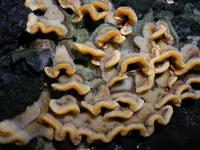
Hairy curtain crust, Stereum hirsutum, is a thin, shelf-like wood-decay fungus rather than a leafy plant. It forms overlapping, fan-shaped brackets with zoned orange, yellow, and brown bands and a distinctly hairy upper surface. The underside stays smooth and lacks pores or gills.

This fungus commonly colonizes dead or dying hardwood branches and logs in woodlands, parks, and gardens across temperate regions, including much of North America and Europe. It is not usually grown as an ornamental, but understanding how to care for hairy curtain crust focuses on providing consistently cool, shaded, and moist woody substrates where the mycelium can establish and feed.

Main Plant Requirements

Care Difficulty

Easy Care

Light Preference

Partial Shade

Water Requirements

Keep Soil Moist

Temperature Preference

Cold Hardy

Hardiness Zone

4–10

Soil Texture

Loamy, Organic-rich, Peaty

Soil pH

Acidic (5.5–6.5), Slightly acidic (6.5–7.0)

Soil Drainage

Moist but well-drained

Fertilization

Minimal (feed rarely)

Get Personalized Care Plan

Scan your plant to receive care tips personalized for your specific plant

Available on iOS and Android

How to Care for the hairy curtain crust

Stereum hirsutum is a wood-decaying fungus that thrives in shaded woodland light rather than direct sun.

  • Provide dappled or filtered light under tree canopies; 1–3 hours of weak morning sun is acceptable, but avoid direct midday and afternoon sun.
  • Choose locations with bright shade on north or east sides of trees or logs, as hairy curtain crust maintains color and texture best out of direct radiation.
  • In summer, increased canopy cover naturally reduces light; in winter, brief low-angle sun through bare branches is usually harmless and does not require shading.

Stereum hirsutum depends on consistently moist but not waterlogged wood rather than surface watering.

  • Select well-drained sites where rain can soak in, then slowly evaporate; avoid hollows where water stands for more than 24 hours.
  • Aim for wood that feels evenly damp 0.5–2 cm below the surface; deep cracks, brittleness, or pale, shriveled margins suggest underwatering conditions.
  • Blackened tissue, slimy patches, or strong sour odor from the wood indicate excess saturation or competing rot, so improve drainage or airflow instead of adding water.

This fungus tolerates a wide temperature range but grows most actively in mild, moist conditions.

  • Optimal growth usually occurs around 50–70°F (10–21°C), especially during cool, damp spring and autumn weather.
  • The organism can survive short drops near 20°F (-6°C) within wood, but surface fruiting bodies may be damaged by prolonged hard frost.
  • At 80–90°F (27–32°C), growth slows and fruiting layers may dry or crack, so cooler, shaded, and moist microclimates help maintain stable development.

Humidity is not a significant care factor for Stereum hirsutum, which is typically grown outdoors on dead wood rather than as a humidity-sensitive house specimen.

This wood-decay fungus relies on the substrate wood rather than traditional soil, so focus on providing suitable dead hardwood instead of preparing a soil mix.

  • Use undecayed or lightly decayed hardwood logs or branches, ideally oak, maple, or similar broadleaf species, with intact bark to support stable colonization.
  • Keep wood in a consistently moist but not submerged environment, such as a shaded, rain-exposed spot where surfaces can dry slightly between wettings.
  • Avoid burying the wood in dense soil or compost that stays waterlogged, since poor aeration restricts fungal respiration and slows mycelial spread.
  • If partial soil contact is unavoidable, use loose, coarse material like partially decomposed wood chips and bark to maintain airflow around the colonized wood.

This species is not well suited to conventional container growing, since it naturally colonizes outdoor dead wood rather than forming a root system in potting media.

Stereum hirsutum is a saprophytic fungus that breaks down wood and generally does not need added fertilizer in garden or indoor culture.

Pruning is rarely required for Stereum hirsutum, since this fungus naturally forms thin, layered brackets on dead or decaying wood.

Transplanting Stereum hirsutum focuses on moving colonized wood rather than disturbing the fungal tissue directly.

  • Shift only when the host log is fully colonized or when wood is decaying to the point of breaking apart.
  • Transplant in cool, moist weather in spring or fall to limit desiccation of the fungal tissue.
  • Move the entire piece of wood to a similar shaded, humid site rather than scraping off fruiting bodies.
  • Handle the substrate gently to avoid cracking the wood and drying the mycelium, then keep the new site evenly moist.

Propagation of Stereum hirsutum for hobby purposes is uncommon and technically demanding, so it is usually left to natural spore spread.

This wood-decay fungus is naturally cold hardy in temperate climates and generally needs no special winter care.

Care Tips

Select Proper Substrate

Attach the fungus to seasoned, non-treated hardwood logs or branches (oak, beech, maple, fruitwood), as resinous softwoods and fresh-cut wood slow colonization and reduce reliable fruiting.

Mimic Log Position

Mount colonized wood sections vertically or slightly angled, as in natural woodland settings, to reduce water pooling on the fruiting bodies and extend their lifespan and color clarity.

Maintain Log Moisture

If logs are kept under cover or in a sheltered spot, periodically hose them down or briefly soak the lower section so the wood core stays damp without leaving the bark submerged for long periods.

Control Air Movement

Place colonized wood where there is gentle airflow but not constant strong wind, since steady light air movement discourages mold overgrowth on the fruiting layers while preventing excessive drying.

Monitor Competing Fungi

Check the wood regularly and remove any soft, slimy, or fast-spreading competing fungi by cutting away affected bark sections, which helps when growing hairy curtain crust on the same log for longer periods.

Common Pests and Diseases

White rot on hardwoods

This disease reflects the natural wood-decaying action of the fungus on weakened or dead hardwood tissues. Symptoms include pale, fibrous, and stringy wood where the fungus has broken down lignin while leaving cellulose more intact.

Solution

Management focuses on tree health and structural safety rather than curing the fungus. Prune out and safely dispose of heavily colonized dead branches, avoid wounding living trees, and, where structural integrity is a concern, consult an arborist to remove or reduce infected limbs or entire trees to limit hazards and reduce new substrate for growing hairy curtain crust.

Basidiome parasitism

This disease occurs when other fungi parasitize the fruiting bodies of hairy curtain crust, leading to distorted, discolored, or overgrown brackets. Symptoms include unusual surface growths, patches of different color or texture, and premature deterioration of the brackets.

Solution

Management is mainly cosmetic and ecological. Remove and discard heavily parasitized fruiting bodies if a clean culture or appearance is desired, and reduce prolonged wet, stagnant conditions on stacked logs or display wood to limit secondary fungal overgrowth.

Bark and wood borers

These insects use the same dead or weakened wood substrates as the fungus, creating galleries beneath the bark and through the decaying sapwood. This pest often accelerates structural breakdown of logs or ornamental wood pieces colonized by the fungus.

Solution

To manage borers on decorative or structural wood, store wood in well-ventilated, dry conditions, remove and discard pieces with heavy tunneling, and avoid stacking infested wood near sound structures. Kiln-drying, solarizing (enclosed sun exposure), or freezing small pieces can help kill existing larvae before using the wood for display with Stereum hirsutum care instructions.

Interesting Facts

Crust with hairy zones

This fungus forms thin, bracket-like crusts with densely hairy upper surfaces that develop distinct concentric color zones of yellow, orange, and brown as the fruiting body ages.

Persistent year-round fruiting

Individual fruit bodies are tough and leathery, often persisting on dead hardwood for many months, so the same patch can be visible across multiple seasons while new layers grow at the margins.

Important wood decomposer

It is a saprotrophic species that specializes in decomposing dead hardwoods such as oak and beech, contributing to nutrient cycling in temperate forests by breaking down lignin-rich tissues.

Botan icon

Did you know?

This species was long confused with several look-alike crust fungi, and only with modern microscopic study and DNA-based methods has its separation from closely related Stereum species been clarified in detail.

FAQs about hairy curtain crust

Growth is relatively slow and strongly depends on moisture and wood quality. On fresh, damp hardwood, new brackets can form within a season, then expand a few millimeters per year as the underlying dead wood gradually decays.

Grow Healthy Plants with Botan Care

Keep your plants happy and healthy with plant identification, disease detection, and easy care guidance.

Botan plant care app — identify plants on mobile

Explore More Plants