fuzzyfruit nightshade Care (Solanum candidum)

fuzzyfruit nightshade

About fuzzyfruit nightshade

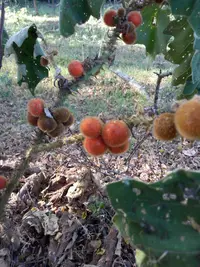
Fuzzyfruit nightshade (Solanum candidum) is a small shrub or bushy perennial from South America, grown mainly for its unusual hairy fruits. The plant forms dense, branching growth with broad leaves and rounded, bristly berries that start green and ripen to yellow or orange. It occurs naturally in higher-altitude tropical regions, where conditions are mild and humid. In cultivation it can be somewhat demanding, as it dislikes cold, poor drainage, and very dry air. It prefers bright light, regular moisture, and fertile, well-drained soil, so those factors are key when learning how to care for fuzzyfruit nightshade.

Main Plant Requirements

Care Difficulty

Moderate Care

Light Preference

Full Sun

Water Requirements

Regular Water

Temperature Preference

Tropical / Frost Sensitive

Hardiness Zone

10–11

Soil Texture

Loamy, Sandy, Organic-rich

Soil pH

Acidic (5.5–6.5), Slightly acidic (6.5–7.0)

Soil Drainage

Moist but well-drained

Fertilization

Light (every 4–6 weeks)

Get Personalized Care Plan

Scan your plant to receive care tips personalized for your specific plant

Available on iOS and Android

How to Care for the fuzzyfruit nightshade

This subtropical shrub prefers bright exposure with protection from harsh midday sun.

  • Provide 4–6 hours of direct morning sun with light afternoon shade; in hot climates, give filtered light after 12 p.m. to prevent leaf scorch on fuzzyfruit nightshade.
  • Tolerates light partial shade, but flowering and fruiting decline if it receives less than 3–4 hours of direct or strong dappled light per day.
  • In cooler seasons, allow more direct sun, while in summer gradually acclimate plants outdoors to prevent sudden sunburn on tender new growth.

This species prefers evenly moist, well-drained soil that never stays waterlogged.

  • Water when the top 3–5 cm of soil feel dry, soaking the root zone deeply then letting excess drain away to support steady growth of Solanum candidum.
  • Reduce watering slightly in cooler months when growth slows, but do not allow the soil to dry out completely for more than 1–2 days.
  • Watch for yellowing, soft leaves or a sour soil smell as signs of overwatering, and for limp, dull leaves and dry, crumbly soil as signs of underwatering.

This plant grows best in warm, frost-free conditions with only moderate heat tolerance.

  • Aim for 65–80°F (18–27°C) during active growth, which supports steady vegetative and fruit development.
  • Protect from cold; growth slows below 55°F (13°C), and tissue damage occurs near 40°F (4°C), so avoid any frost exposure.
  • In hot regions, plants tolerate short periods up to 90°F (32°C) if soil moisture is stable and roots are mulched, but prolonged extreme heat can reduce flowering.

This species prefers moderately humid air but usually adapts to typical household levels if not extremely dry.

  • Aim for 40–60% humidity to keep foliage and developing fruits from drying at the edges.
  • In very dry air, watch for leaf tip browning, curling, and stalled new growth as signs of humidity stress.
  • Increase humidity by grouping plants, placing the pot near (not on) a pebble tray with water, or using a small room humidifier for fuzzyfruit nightshade.

Solanum candidum grows best in loose, well-aerated, evenly moist soil that drains quickly.

  • Use a loamy, organic-rich mix made from roughly 50% peat or coco coir, 30% compost, and 20% perlite or coarse sand.
  • Ensure rapid drainage so water runs freely from the pot base, preventing waterlogging that leads to root rot.
  • Aim for slightly acidic to neutral pH, around 6.0–7.0, which supports balanced nutrient uptake.
  • Improve aeration by avoiding compaction, incorporating chunky bark or perlite, and never planting directly into heavy clay alone.

This species is suitable for container growing when the pot size and stability match its vigorous root and top growth.

  • Choose a deep, wide container so roots can spread laterally and anchor the plant against wind or top-heavy growth.
  • Select a heavier material such as ceramic or thick plastic to reduce tipping once stems and fruit add weight.
  • Place the container where it can be staked or trellised, since supportive structures keep the plant upright and reduce root disturbance from leaning.

Solanum candidum benefits from modest, consistent feeding during its active growing season.

  • Use a balanced liquid fertilizer (for example 10-10-10 or 20-20-20) diluted to 1/2 strength every 4–6 weeks in spring and summer.
  • Alternatively, apply a light layer of compost or a slow-release granular fertilizer at the start of the growing season.
  • Pause or reduce feeding to 1/4 strength in fall and winter when growth slows.
  • For fuzzyfruit nightshade in containers, ensure thorough watering after feeding to prevent root burn.

Solanum candidum responds well to light structural pruning that maintains a manageable, fruitful shrub.

  • Carry out main pruning in late winter or early spring before vigorous new growth begins.
  • Remove dead, diseased, crossing, or weak shoots with clean, sharp hand pruners to improve airflow and light penetration.
  • Shorten overly long stems to shape the plant and encourage bushier growth and better fruiting.
  • Disinfect blades between plants, especially after cutting diseased wood, to limit pathogen spread.

This species is often grown as a landscape shrub, so attention focuses more on transplanting than frequent repotting.

  • Transplant young plants in spring after frost risk has passed, when soil is workable and warming.
  • Look for roots circling the pot, water running straight through, or slowed growth as signs a container plant needs more space.
  • Move up only 1–2 pot sizes, handling the root ball gently and loosening tightly bound roots slightly.
  • Water thoroughly after planting, then keep soil evenly moist and shaded for 3–5 days to reduce transplant shock.

Solanum candidum is usually propagated from seed but can also be raised from semi-ripe cuttings under controlled conditions.

  • Sow fresh, cleaned seeds in late winter–spring in a sterile, well-drained seed mix at 70–80°F with bright, indirect light.
  • Keep the seed medium evenly moist, not waterlogged, since fluctuating moisture reduces germination rates.
  • For cuttings, take 10–15 cm semi-ripe shoots in late spring–summer, removing lower leaves.
  • Insert cuttings into moist, free-draining mix, optionally with rooting hormone, and maintain high humidity until rooted.

This subtropical shrub is frost-sensitive and needs protection in climates with freezing winters.

  • In-ground plants in mild zones benefit from 5–8 cm of organic mulch around the root zone, kept away from the stem base.
  • Where hard frost occurs, grow Solanum candidum in containers and move indoors or into a greenhouse before temperatures drop below 40°F.
  • Provide a cool, bright indoor spot and reduce watering in winter to avoid saturated, cold soil.

Care Tips

Use sturdy staking

Install a strong stake or small trellis when the plant is still young and loosely tie the main stems with soft ties, as the heavy fruits and brittle branches can snap in wind or under their own weight.

Thin developing fruit

Once fruit set is heavy, remove a portion of small, crowded fruits so the remaining ones size up better and the branches are less likely to break under the load.

Mulch for root cooling

Apply a 5–8 cm layer of organic mulch around, but not touching, the stem to keep roots cooler in summer, reduce weed competition, and maintain more even soil moisture.

Monitor for mite damage

Inspect the fuzzy leaf undersides with a hand lens every 1–2 weeks in warm, dry weather and treat early if stippling or fine webbing appears, since spider mites can be attracted to its dense hairs.

Winter protection strategy

In marginal climates, grow Solanum candidum in a large container that can be moved to a bright, frost-free space for winter, then gradually reintroduce it to outdoor sun in spring to prevent shock and leaf scorch.

Common Pests and Diseases

Whiteflies

These insects feed on the undersides of leaves, causing yellowing, leaf drop, and sticky honeydew that encourages sooty mold. This pest is often attracted to the soft new growth and dense foliage of Solanum species grown in warm, sheltered spots.

Solution

Reduce numbers by regularly shaking branches to dislodge adults and rinsing the undersides of leaves with a strong but controlled stream of water. For persistent infestations, use insecticidal soap or a neem oil spray every 7–10 days, and remove heavily infested leaves to slow reproduction when caring for fuzzyfruit nightshade.

Spider mites

These pests thrive in hot, dry conditions and puncture leaf cells, leading to stippling, bronzing, and fine webbing between leaves and stems. Symptoms include dull, dusty-looking foliage and gradual decline in vigor.

Solution

Increase humidity around the plant and hose down foliage, focusing on leaf undersides, to physically remove mites and webs. Follow with repeated applications of insecticidal soap or a horticultural oil labeled for mites, and avoid water stress to reduce susceptibility.

Fruit borers

These caterpillars bore into the fuzzy fruits, leaving small entry holes, frass, and internal damage that causes premature fruit drop or collapse. This pest directly reduces edible yield and makes fruits unfit for consumption.

Solution

Inspect developing fruits frequently and remove and destroy any that show small holes or decay to break the life cycle. Use fine insect netting around fruiting branches, encourage beneficial predators, and, if pressure is high, apply a Bacillus thuringiensis (Bt) biological spray to young caterpillars according to label directions.

Bacterial leaf spot

This disease causes small, water-soaked spots on leaves that enlarge, turn dark, and may be surrounded by yellow halos, sometimes leading to tattered foliage. Symptoms include defoliation in warm, humid conditions, especially where leaves stay wet for long periods.

Solution

Remove and discard infected leaves, avoid overhead watering, and water early in the day so foliage dries quickly. Improve spacing and airflow, disinfect pruning tools, and do not save seed from infected plants; in severe cases, replace plants and avoid planting Solanum species in the same spot for several years.

Early blight

This disease produces brown leaf spots with concentric rings and often starts on older lower leaves, gradually moving upward and reducing photosynthesis. Symptoms include yellowing, leaf drop, and poor fruit development in warm, moist weather.

Solution

Promptly remove affected leaves and fallen debris to limit spread, and stake or prune plants to keep foliage off the soil and improve air movement. Use drip irrigation rather than overhead watering, mulch around the base to reduce soil splash, and in high-pressure areas consider using a copper-based fungicide preventively during warm, wet periods.

Interesting Facts

Distinctive woolly fruits

The ripe berries develop a dense, felt-like covering of hairs, which gives them a characteristic fuzzy texture unlike many other edible Solanum species.

Andean cloud‑forest origin

This species is native to cool, moist Andean regions of South America, where it grows as a shrub or small tree along forest edges and disturbed slopes.

Close relative of naranjilla

Solanum candidum is part of the same clade as naranjilla (Solanum quitoense) and cocona (Solanum sessiliflorum), sharing similar soft, aromatic fruits adapted to bird and mammal dispersal.

Botan icon

Did you know?

In its native range, Solanum candidum is sometimes used in local breeding and selection work as a potential genetic resource to improve fruit quality traits such as flavor or hardiness in related underutilized Solanum fruit crops.

FAQs about fuzzyfruit nightshade

Yes, this species grows readily from fresh, fully ripe seeds. Clean and dry them, then sow shallowly in warm, consistently moist substrate. Germination is often uneven and slow, so maintain warmth and moisture for several weeks.

Grow Healthy Plants with Botan Care

Keep your plants happy and healthy with plant identification, disease detection, and easy care guidance.

Botan plant care app — identify plants on mobile

Explore More Plants