Habitat replica
When choosing a site, mimic its natural conifer woodland setting by placing fruiting containers or inoculated logs in a shaded, undisturbed area under or near pines or spruces with a thick, slightly decomposed needle layer.

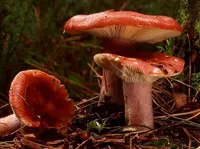
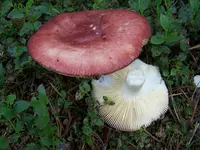
Bloody brittlegill, Russula sanguinaria, is a red-capped woodland mushroom rather than a traditional garden plant. It has a fragile, easily breaking cap and stem, which gives the group name brittlegill.
This species usually appears in coniferous forests, especially among pines, often in carpets of moss. It forms a mycorrhizal partnership, sharing nutrients with tree roots, so it cannot be grown like a normal potted plant.
Because of this close tree association, attempts to care for Bloody Brittlegill at home are rarely successful. In nature it favors cool, moist, acidic forest soils with dappled light under established trees.

Care Difficulty
Hard Care

Light Preference
Partial Shade

Water Requirements
Keep Soil Moist

Temperature Preference
Cool Climate

Hardiness Zone
Unknown

Soil Texture
Loamy, Silty, Organic-rich

Soil pH
Strongly acidic (4.5–5.5), Acidic (5.5–6.5)

Soil Drainage
Moist but well-drained

Fertilization
Minimal (feed rarely)
Scan your plant to receive care tips personalized for your specific plant
Available on iOS and Android
This forest mushroom prefers cool, shaded woodland light rather than direct sun exposure.
This ectomycorrhizal mushroom depends on evenly moist, well-drained forest soil rather than direct watering.
This species fruits best in cool to mild conditions typical of late summer and autumn woodlands.
This ectomycorrhizal fungus does not have meaningful humidity management options for cultivation, so moisture control focuses on soil rather than air.
This mycorrhizal mushroom relies on naturally structured forest soils rather than prepared garden mixes.
This species is not suitable for container growing, as it depends on complex ectomycorrhizal relationships with living trees in natural soil profiles.
Russula sanguinaria is a mycorrhizal woodland fungus that typically does not need direct fertilization when growing in natural soil with leaf litter.
Russula sanguinaria does not require pruning, as individual mushroom fruiting bodies are short-lived and do not benefit from shaping or cutting.
This fungus is not suited to normal container culture, so focus on maintaining suitable trees and soil rather than repotting Russula sanguinaria itself.
Propagation of Russula sanguinaria is specialized and rarely attempted by home growers, because it depends on complex mycorrhizal relationships with trees rather than simple cuttings or spores on standard medium.
In natural climates this forest fungus is cold hardy and does not need specific winter care beyond conserving its woodland habitat.

Plant Health Check
Not sure what's wrong with your plant? Check your plant's health inside the app.
This species contains hemolysins, compounds that can damage red blood cells when raw, which is why it is considered inedible and potentially toxic, especially if undercooked or consumed in quantity.
It forms ectomycorrhizal partnerships with conifers such as pine and spruce, exchanging mineral nutrients for sugars and contributing significantly to nutrient cycling in acidic, needle-rich forest soils.
Despite its striking blood-red cap and association with toxicity, many collections show only a mild to moderately acrid taste, illustrating how cap color alone is not a reliable indicator of edibility or toxicity in russulas.

Molecular studies place this fungus in a lineage of red-capped russulas adapted to nutrient-poor, acidic coniferous soils, suggesting that its vivid pigments and specific mycorrhizal preferences evolved together as part of a specialized forest survival strategy.
This mushroom is considered inedible and potentially harmful. It contains irritating compounds that can cause gastrointestinal upset such as nausea, vomiting, and diarrhea. It should not be collected for food or tasted, even in small amounts.
Keep your plants happy and healthy with plant identification, disease detection, and easy care guidance.