

Host tree pairing
Establish this mycorrhizal fungus near compatible conifer hosts such as pines or spruces, as successful growing Primrose Brittlegill depends on close association with suitable tree roots rather than on substrate alone.

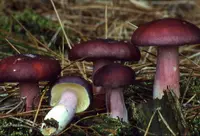
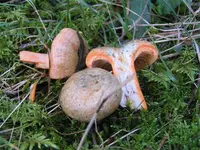
Primrose brittlegill (Russula sardonia) is a small to medium woodland mushroom, not a houseplant. It forms mycorrhizal partnerships with tree roots, especially pines and other conifers. Caps are typically pinkish to purple-red with pale gills and a brittle, chalky stem. The flesh breaks cleanly, a common trait in Russula species.
This species occurs mainly in temperate forests across Europe and parts of North America, usually in acidic, well-drained soils. It is considered inedible and is not suitable for casual cultivation. For those studying how to care for Primrose Brittlegill in managed woodland or research settings, it is important to replicate its natural tree partners and soil conditions.

Care Difficulty
Moderate Care

Light Preference
Partial Shade

Water Requirements
Keep Soil Moist

Temperature Preference
Cool Climate

Hardiness Zone
Unknown

Soil Texture
Loamy, Peaty, Organic-rich

Soil pH
Strongly acidic (4.5–5.5), Acidic (5.5–6.5)

Soil Drainage
Moist but well-drained

Fertilization
Minimal (feed rarely)
Scan your plant to receive care tips personalized for your specific plant
Available on iOS and Android
This ectomycorrhizal fungus thrives in dappled woodland light rather than direct, open sun.
This forest mushroom depends on consistently moist, well-drained soil around its host trees rather than direct watering of the fungus itself.
This species is adapted to cool, temperate woodland conditions and fruits best in mild weather.
Humidity management is not relevant for Russula sardonia, which grows as a wild ectomycorrhizal fungus in outdoor woodland conditions rather than a managed houseplant.
Russula sardonia grows naturally in association with conifer roots, so soil preparation focuses on recreating acidic, well-aerated woodland conditions.
This species is not suitable for container growing, as it relies on complex mycorrhizal partnerships with conifer roots in open ground rather than pot culture.
Russula sardonia is a wild mycorrhizal fungus that should not be fertilized directly, since added nutrients disrupt its natural soil partnership with host trees.
Russula sardonia is a woodland fungus and is not pruned in the horticultural sense, but minor clean-up can improve site hygiene.
This ectomycorrhizal fungus is not suited to conventional containers; transplanting focuses on preserving its association with compatible trees rather than moving individual mushrooms.
Propagation of Russula sardonia is specialist work because the fungus depends on a living tree partner and cannot be raised like typical garden plants.
Russula sardonia is naturally cold hardy in its native woodland habitats and generally needs no targeted winter care.

Plant Health Check
Not sure what's wrong with your plant? Check your plant's health inside the app.
The gills of this species typically turn yellow when a drop of alkali such as ammonia solution is applied, a chemical reaction that helps distinguish it from many similar purple russulas in the field.
Although not deadly, this mushroom is considered inedible because its flesh and gills have a very strong, persistent bitter and acrid taste that can cause gastrointestinal upset if eaten.
This species is strongly associated with acidic soils and often forms mycorrhizal partnerships with Scots pine and other conifers, making it a characteristic mushroom of heathlands and coniferous woodland on poor, sandy ground.

Molecular and morphological studies indicate that this species belongs to a distinct group of russulas with high concentrations of pungent sesquiterpenes, compounds thought to contribute both to its acrid taste and to its natural deterrence against many mushroom-feeding invertebrates.
This mushroom is considered inedible and is often reported as poisonous, causing strong, immediate bitterness and gastrointestinal upset. It should never be collected for food, even when other wild mushrooms in the area appear safe.
Keep your plants happy and healthy with plant identification, disease detection, and easy care guidance.

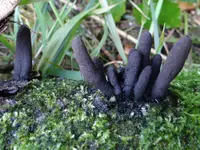
Dead Moll's Fingers
Xylaria longipes
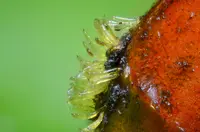
Hesperomyces virescens
Hesperomyces virescens
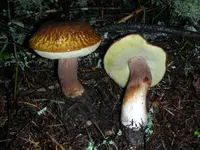
Boletus fibrillosus
Boletus fibrillosus
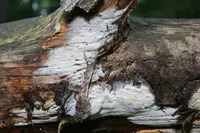
Flavidoporia pulvinascens
Flavidoporia pulvinascens
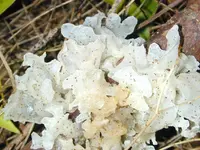
snow fungus
Tremella fuciformis
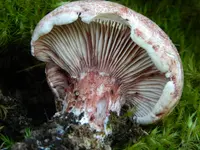
pinkmottle woodwax
Hygrophorus russula
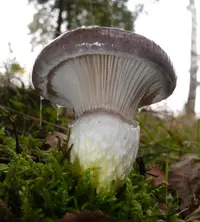
Slimy Spike
Gomphidius glutinosus
Orange-latex Milky
Lactarius deterrimus