Host tree pairing
Establish this mycorrhizal fungus near compatible host trees such as pine, spruce, or birch, and avoid disturbing roots so the underground association can form and persist.

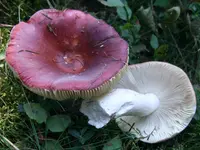
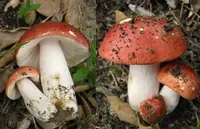
Darkening brittlegill (Russula vinosa) is a gilled mushroom, not a leafy houseplant. It forms firm, brittle caps that start reddish to wine-colored and gradually darken with age, especially when bruised. The stem is usually pale, and the white gills are closely spaced. Fruiting bodies appear on soil rather than wood.
This species typically grows in coniferous and mixed forests, often in cooler regions of Europe and parts of North America. It lives in symbiosis with tree roots, so it cannot be grown like a normal potted plant. For those studying how to care for Darkening Brittlegill, conditions must mimic its natural woodland habitat with undisturbed soil, consistent moisture, and shade.

Care Difficulty
Hard Care

Light Preference
Partial Shade

Water Requirements
Keep Soil Moist

Temperature Preference
Cool Climate

Hardiness Zone
Unknown

Soil Texture
Loamy, Peaty, Organic-rich

Soil pH
Strongly acidic (4.5–5.5), Acidic (5.5–6.5)

Soil Drainage
Moist but well-drained

Fertilization
Minimal (feed rarely)
Scan your plant to receive care tips personalized for your specific plant
Available on iOS and Android
This forest mushroom prefers cool, dappled light under trees rather than open sun exposure.
This species depends on consistently moist, not waterlogged, forest soil to form mushrooms.
This mushroom fruits best in cool to mild conditions typical of temperate forests.
Humidity has little direct relevance because this woodland fungus relies mainly on soil moisture around tree roots.
This mycorrhizal fungus depends on natural forest soil rather than prepared potting mixes.
This species is not suitable for container growing because it requires a living tree partner and complex forest soil conditions.
Russula vinosa is a wild mycorrhizal mushroom that usually needs no fertilization when growing with suitable host trees in natural or semi-natural soil.
Russula vinosa does not require pruning, since it is a mushroom fruiting from underground mycelium rather than a plant with stems or branches.
This fungus is not suited to standard repotting; instead, focus on establishing and maintaining an appropriate woodland-style habitat for fruiting.
Propagation of Russula vinosa is specialized and usually attempted only by experienced mycorrhizal growers or in research settings, not by casual gardeners.
Russula vinosa occurs in cold and temperate forests and needs no active winter care in the ground when growing with suitable host trees.

Plant Health Check
Not sure what's wrong with your plant? Check your plant's health inside the app.
The cap of this species starts a deep wine-red but often fades to yellowish or ochre tones with age or strong light exposure, which helps distinguish it from similar red-capped Russula species that stay bright red longer.
Russula vinosa forms ectomycorrhizal partnerships with birch and some conifers, exchanging mineral nutrients for sugars from the tree roots and typically appearing in mixed or coniferous forests where these hosts are present.
The flesh is unusually firm yet characteristically brittle, snapping cleanly rather than bending, and it stays white without reddening or greening when cut, which is a key field feature separating it from some toxic red-capped look-alikes.

In parts of northern and eastern Europe, this mushroom is considered one of the more valued edible Russula species and is traditionally collected, carefully distinguished from similar inedible red russulas, and preserved by drying or salting for later use.
This species is considered edible in many European sources, with a mild taste and firm texture. However, correct identification is critical, since many red Russula species are toxic. Only eat specimens confidently verified by an experienced mycologist.
Keep your plants happy and healthy with plant identification, disease detection, and easy care guidance.