Salinity management
Rotate irrigation between seawater or saline solution and low-salinity water to prevent salt crust forming on the soil surface while still meeting this halophyte’s high salt requirement.

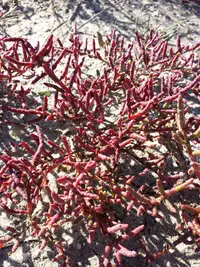
Perennial-jointed glasswort (Salicornia perennans) is a small, succulent saltmarsh plant adapted to highly saline, often tidal environments. It forms low, jointed, leafless stems that look like segmented green twigs turning red or purple later in the season.
This species is native to coastal and inland salt flats in North America and parts of Eurasia, where it grows in salty mud or sandy substrates. Its strong salt tolerance and compact size can make it interesting for experimental coastal gardens and habitat-style plantings.
Because it needs high salinity and consistently moist conditions, it is more specialized and harder to maintain in typical garden soil. Anyone wanting to learn how to care for perennial-jointed glasswort should understand its need for full sun, saline substrates, and regular exposure to moisture.

Care Difficulty
Moderate Care

Light Preference
Full Sun

Water Requirements
Aquatic

Temperature Preference
Cold Hardy

Hardiness Zone
4–9

Soil Texture
Sandy, Silty

Soil pH
Neutral (7.0), Slightly alkaline (7.0–7.5)

Soil Drainage
Waterlogged tolerant

Fertilization
Minimal (feed rarely)
Scan your plant to receive care tips personalized for your specific plant
Available on iOS and Android
This coastal halophyte thrives in strong sun exposure that mimics open salt marsh conditions.
This salt-marsh species prefers consistently moist, even wet, conditions rather than fluctuating drought.
This species is adapted to temperate coastal climates with cool to warm growing seasons and mild winters.
This coastal halophyte prefers very humid, maritime air but adapts to a broad humidity range if soil salinity is correct.
Salicornia perennans needs saline, sandy, fast-draining substrate that still holds some moisture around the roots.
This species can grow in containers if the pot mimics a shallow, coastal, saline substrate.
This salt-marsh halophyte usually thrives without added fertilizer, especially in nutrient-rich coastal soils.
Pruning needs for Salicornia perennans are minimal and mainly cosmetic.
Transplanting is more relevant than repotting, as this species is usually grown in coastal beds or marsh restorations.
Salicornia perennans is commonly propagated by seed and soft stem cuttings in controlled saline conditions.
This species is cold hardy in many coastal climates and usually needs little dedicated winter care.

Plant Health Check
Not sure what's wrong with your plant? Check your plant's health inside the app.
This species survives in salty mudflats by storing excess salt in specialized vacuoles within its succulent jointed stems, then shedding the older, salt-loaded segments as they age and break off.
Populations often turn from green to orange-red or purplish tones in late season as pigments called anthocyanins accumulate, especially under high salinity and strong light.
Dense stands help trap fine sediments and organic matter in coastal marshes, contributing to long-term carbon storage in these tidal soils and supporting shoreline stability.

This plant is a facultative annual-perennial halophyte, meaning that in some locations it completes its life cycle in 1 year, while in others genetically similar plants persist as short-lived perennials depending on local stress from salinity, flooding, and frost.
The young, tender shoots are edible and often used as a salty vegetable or garnish. They accumulate salt, so should be rinsed and, if desired, briefly blanched. Avoid harvesting from polluted shorelines or industrial salt ponds.
Keep your plants happy and healthy with plant identification, disease detection, and easy care guidance.